
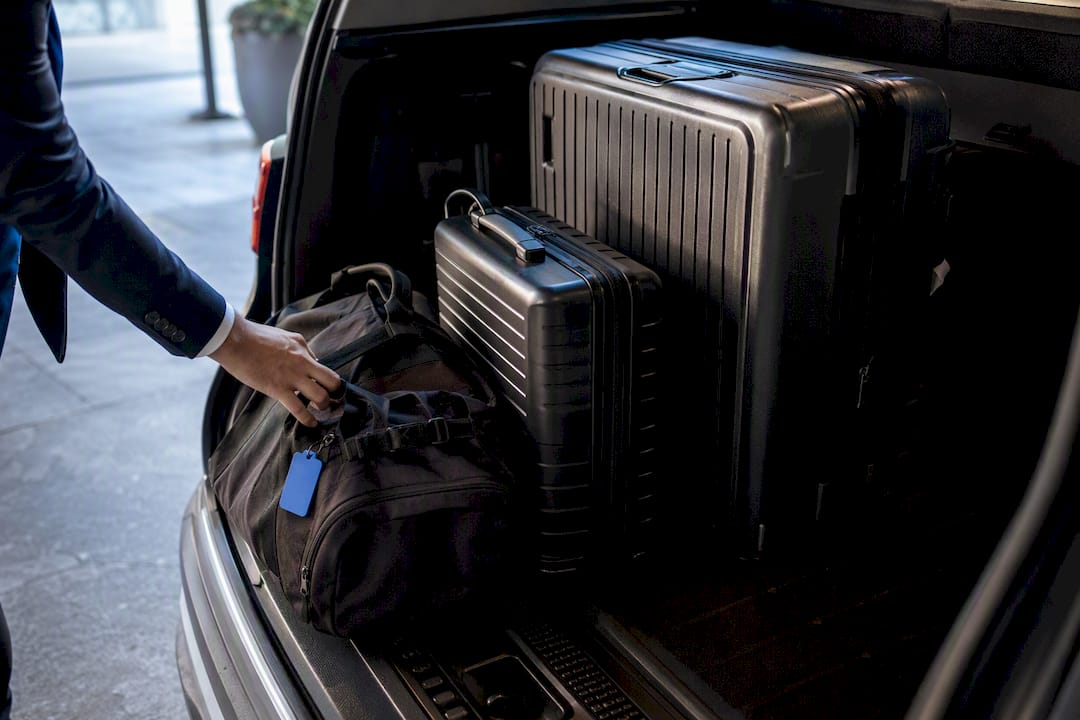
Full-size SUVs like the GMC Yukon XL and Chevrolet Suburban carry the most gear, often topping around 144.5 cubic feet with the seats folded. Midsize three-row models such as the Chevrolet Traverse and Toyota Grand Highlander Hybrid offer close to 97.5 cubic feet at their maximum cargo volume. But raw cubic feet is the wrong number to shop by. Suitcase counts and behind-third-row space tell you what will actually fit.
TL;DR:
- Suitcase count and opening dimensions provide a more accurate measure of real-world luggage capacity than raw cubic footage.
- Larger SUVs like the Yukon XL and Suburban offer around 144.5 cubic feet max, suitable for heavy gear and large groups.
- Many SUVs with similar published capacities can differ by two or more suitcases due to measurement methods and interior shapes.
- Folding seats flat and verifying behind-third-row space are crucial steps for accurately assessing an SUV’s true luggage-carrying ability.
- Booking a vehicle should include confirming luggage and passenger counts, not just relying on max cargo specs.
Table of Contents
- How does SUV luggage capacity break down by segment?
- How is cargo volume actually measured?
- What does SUV luggage capacity look like in real suitcases?
- How do you choose the right SUV for your luggage needs?
- What packing strategies actually expand usable capacity?
- How should you communicate luggage needs when booking a car service?
- Where can you verify these cargo numbers yourself?
- The real lesson on SUV cargo space
- Sources
How does SUV luggage capacity break down by segment?
Cargo space climbs in fairly predictable steps as you move up in vehicle class, though there are surprises at every level. Here’s how the segments stack up when you’re trying to figure out how much luggage fits in an SUV.
Compact and subcompact SUVs typically offer 20 to 30 cubic feet behind the rear seats. That’s roughly two large suitcases and a couple of backpacks. Fine for a weekend getaway for two, tight for anything more.
Midsize two-row SUVs step up meaningfully. The Subaru Outback holds about 34.6 cubic feet behind the second row and 80.5 cubic feet with seats folded flat, according to MotorTrend’s testing. That’s enough for four to five checked bags when the back seat stays up, or a serious haul when it doesn’t.
Midsize three-row SUVs balance passenger seating with real cargo volume, and this is where most family shoppers land. Consider:
- Chevrolet Traverse: around 22.9 cubic feet behind the third row, 56.6 cubic feet behind the second row, and roughly 97.6 cubic feet max with everything folded, per Bentonville Chevrolet’s spec breakdown.
- Toyota Grand Highlander Hybrid: about 97.5 cubic feet of total cargo volume, making it one of the strongest hybrids in this class for space, according to Edmunds.
For a larger SUV option, see details on the Toyota Fortuner rental to understand cargo and utility capabilities.
- GMC Acadia: competitive third-row folding capacity, though its behind-third-row number runs smaller than the Traverse’s.
- Hyundai Palisade, Honda Pilot, Kia Sorento: all cluster in similar territory, with meaningful gaps in behind-third-row space that matter more than their max figures suggest.
Full-size SUVs are the segment to choose when you need to move serious volume. The GMC Yukon XL and Chevrolet Suburban both land near 144.5 cubic feet max, according to iSeeCars’ cargo rankings, making them the practical pick for large groups with heavy luggage or bulky gear. A handful of high-cargo hybrid and electric SUVs also rank well on max volume, since battery packaging in some designs frees up floor space rather than eating into it. Still, always check behind-third-row numbers separately. A vehicle can post a huge max figure while offering little room with all seats occupied.
How is cargo volume actually measured?
Manufacturer cubic-foot specs aren’t standardized the way you’d assume. Some automakers measure cargo volume to the roofline; others measure only to the top of the rear seatback. The result is that two SUVs with nearly identical-looking cargo bays can post wildly different numbers, not because one holds more, but because they were measured differently.
The SAE publishes J1100, a recommended practice for describing vehicle dimensions and volumes consistently. Following it, however, is voluntary. Automakers can and do skip it, which is exactly why published specs vary so much between brands and even between model years from the same brand.
Consumer Reports takes a different approach. Testers fit the largest rectangular box that will pass through the cargo opening and still let the hatch close, then they count how many standard suitcases fit behind a raised third row. That pipe-frame box and suitcase-count method captures usable space, not just theoretical volume.
The gap this creates in practice:
- Two SUVs listed at the same cubic footage can differ by two or more suitcases in real capacity.
- A tall, narrow cargo bay measures well on paper but frustrates anyone packing wide items like garment bags or car seats.
- Wheel-well intrusion and floor humps shrink usable space in ways spec sheets don’t show.
Pro Tip: Before trusting a manufacturer’s cubic-foot number, look for a suitcase count or behind-third-row figure from an independent tester. It predicts real fit far better than the max spec alone.
The practical takeaway: when comparing SUV trunk capacity across brands, weight consistent, test-based metrics like suitcase counts and opening dimensions more heavily than the glossy max number on a window sticker.
What does SUV luggage capacity look like in real suitcases?
Testers generally define a checked suitcase as 28 to 30 inches, a carry-on as roughly 21 to 22 inches, and a duffel as soft-sided and flexible enough to wedge into gaps. Here’s roughly what fits by model, translating spec-sheet cubic feet into what you’d actually load:
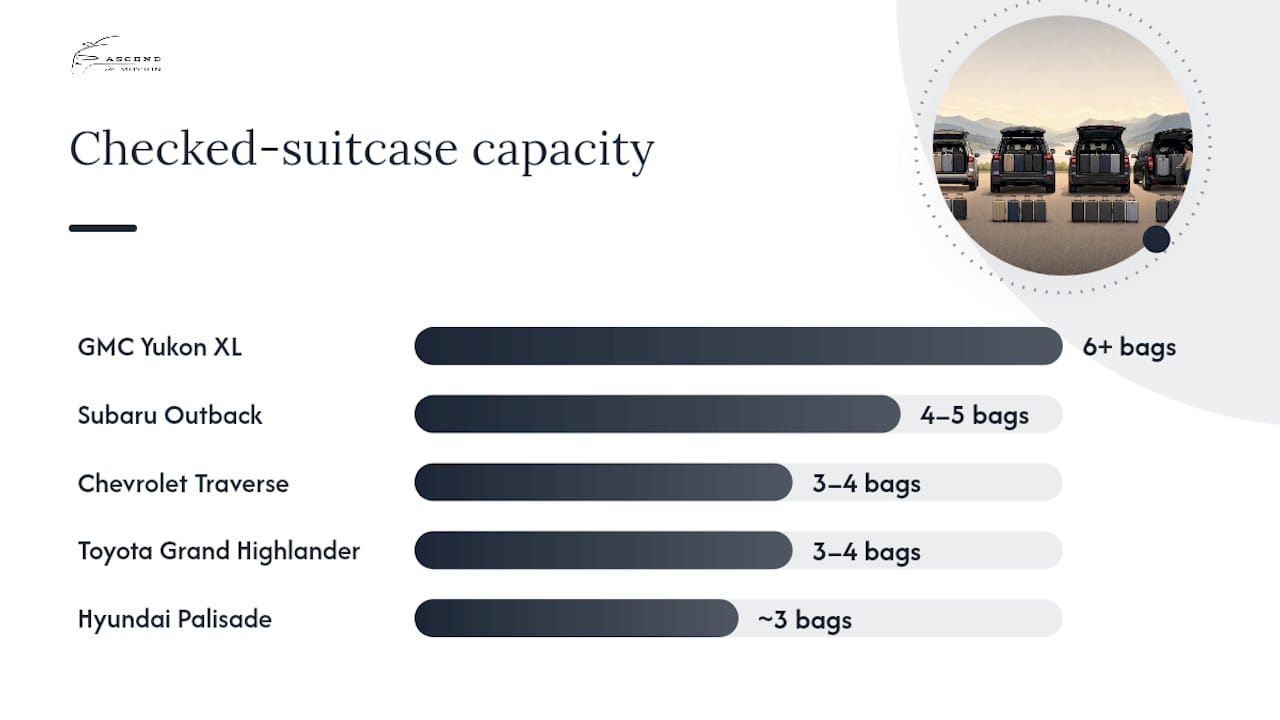
- Chevrolet Traverse: three to four large suitcases behind the third row; family of six with a stroller when the third row folds down.
- Toyota Grand Highlander Hybrid: similar three-to-four bag capacity behind the third row, with strong max volume once both rear rows fold for gear-heavy trips.
- GMC Yukon XL: six or more large suitcases behind the third row alone, making it a top choice for group airport runs or extended family trips.
- Subaru Outback: four to five checked bags behind the second row, since there’s no third row competing for space.
- Hyundai Palisade: roughly three suitcases behind the third row, tight but workable for a family of five on a short trip.
- Honda Pilot: comparable to the Palisade, with a boxier cargo shape that swallows irregular items like golf bags reasonably well.
- Kia Sorento: smaller behind-third-row space than its Telluride-platform cousins, better suited to two-row use with occasional third-row seating.
- GMC Acadia: solid behind-second-row capacity, though its third-row cargo space runs on the smaller side for the segment.
A high cubic-foot number doesn’t guarantee a bag will fit. Door opening width and height, along with wheel-well shape, can block a large suitcase even when the total volume looks generous on paper. A tall duffel might slide in easily where a rigid hard-shell case gets stuck at an angle. That’s the kind of detail a spec sheet never mentions.
For a weekend trip with four adults, most midsize three-row SUVs handle four carry-ons and personal bags without folding a single seat. A family of five with strollers and car seats usually needs the third row folded, pushing you toward the Traverse, Grand Highlander, or Palisade. Moving flat-pack furniture or bulky equipment is really a full-size SUV job. The Yukon XL and Suburban have the floor length and opening height smaller vehicles simply don’t.
How do you choose the right SUV for your luggage needs?
Work through these steps in order, and you’ll avoid the most common mistake shoppers make: falling for a big max-cargo number that doesn’t reflect how they’ll actually load the vehicle.
- Match passenger count to cargo need first. If you’re consistently running six or seven passengers, your usable cargo space shrinks fast, so shop the full-size segment rather than stretching a midsize model.
- Check three specific numbers, not one: cargo behind the third row, cargo behind the second row, and max cargo with everything folded. All three tell a different story about your actual use case.
- Verify the rear opening’s width and height, and ask whether the second and third rows fold flat or require a power switch. A seat that folds at an angle instead of flat eats usable floor space.
- Decide upfront whether a roof box or hitch carrier is acceptable. If not, your luggage needs must fit inside the cargo bay alone, which narrows your model options considerably.
- Weigh fuel and efficiency trade-offs. Full-size SUVs and Sprinter-style vans haul more but cost more to run, so match the vehicle to the trip, not the other way around.
Pro Tip: When calling a dealer or a chauffeured car service, ask for the exact bag count the vehicle handles, not just the cubic-foot spec. Also ask whether a hybrid or EV model’s battery placement intrudes on the cargo floor. Some do.
What packing strategies actually expand usable capacity?
Pack rigid suitcases first, standing them on their edges against the seatbacks, then fill the gaps around them with soft duffels and bags. Irregular space, the kind you find around wheel wells and under a sloped rear window, only works for flexible items, so save your rigid hard-shell cases for the flat floor area.
A roof box or roof rack adds real volume when your trip genuinely exceeds the cargo bay, but it comes with a fuel-economy penalty from added drag and a height restriction for parking garages. A hitch-mounted cargo carrier is often the better trade-off for bulky, weatherproof gear like sports equipment.
Quick accessory guide:
- Use a cargo liner and tie-down straps to keep bags from sliding and to protect the interior on longer drives.
- Distribute weight low and toward the front of the cargo bay, not stacked high behind the rear seats, for better handling.
- Choose a Sprinter-style van over an SUV when you’re moving a group with bulky gear. The floor length and ceiling height handle loads no SUV cargo bay can match.
Pro Tip: If your trip involves golf bags, ski equipment, or more than six pieces of luggage, ask about a van before committing to an SUV. It saves a second vehicle and a second bill.
How should you communicate luggage needs when booking a car service?
Confirm your exact bag count, passenger count, and whether seats need folding before you book. This single step avoids the most common last-minute problem: showing up with more luggage than the reserved vehicle can hold. Ascendinmotion’s vehicle-by-vehicle luggage limit guide breaks down what each class of black minivan and Mercedes-Benz Sprinter actually accepts, so you can match your trip to the right vehicle ahead of time.
When you request a vehicle class, specify whether you need a luxury SUV or a Sprinter, and ask about flat-rate pricing versus extra fees for oversized items like golf bags or ski equipment. Also confirm real-time flight monitoring for airport pickups, meet-and-greet service, and whether power-fold seats are available if your group needs the extra cargo room mid-trip.
Where can you verify these cargo numbers yourself?
Consumer Reports publishes suitcase-count testing and behind-row measurements for most mainstream SUVs. The SAE J1100 standard explains the recommended measurement practice automakers may or may not follow. Edmunds and MotorTrend run independent testing with editorial context, and iSeeCars ranks models by max cargo across every segment.
The real lesson on SUV cargo space
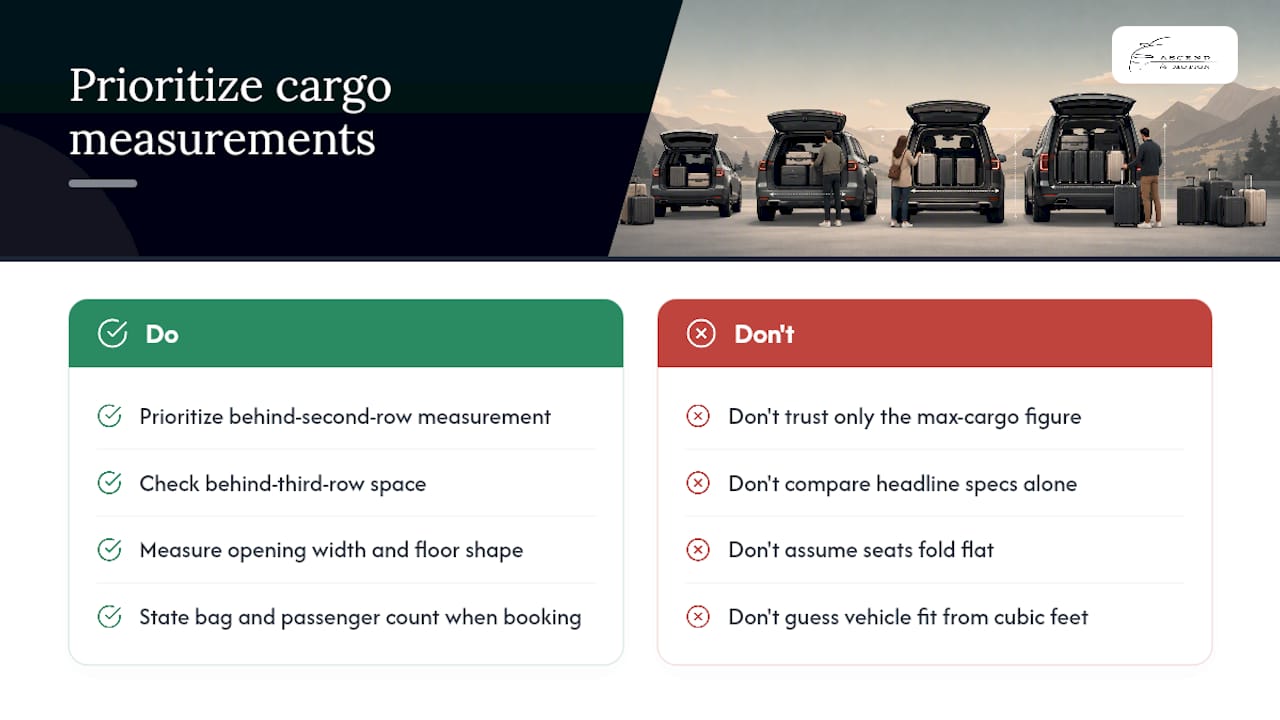
The industry sells cubic feet like it’s a single, comparable number, and that’s the biggest misconception shoppers walk in with. It isn’t. Two SUVs can post identical specs and differ by a full suitcase or more in what actually fits, because measurement height, floor shape, and opening dimensions vary so much between brands. Conventional car-shopping advice tells you to compare max cargo numbers side by side. That’s backwards. Behind-third-row space and suitcase counts predict real-world fit far better than any headline figure.
If you’re choosing a vehicle, or booking one, prioritize the boring numbers: behind-second-row, behind-third-row, opening width, and whether seats fold flat. Save the max-cargo figure for last. It matters most when you’re moving furniture, not luggage. For anyone reserving a chauffeur-driven SUV or Sprinter, that same discipline applies. State your bag count and passenger count clearly, and let the provider match you to the right vehicle rather than guessing from a spec sheet.
— Sirus
Ready to match your luggage to the right vehicle? Ascendinmotion’s luxury airport car service covers LAX transfers and point-to-point trips across Southern California with flat-rate pricing and real-time flight monitoring, so you can book the black minivan or Mercedes-Benz Sprinter that actually fits your bags, not just your passenger count.
Sources
- Cargo room for SUVs and minivans as measured by Consumer Reports
- SAE Standard J1100: Vocabulary for describing vehicle dimensions and volumes
- 2024 Toyota Grand Highlander Hybrid features & specs — Edmunds
- Ranked: The 15 midsize SUVs with the most cargo room — MotorTrend

