

When you book a chauffeur-driven car service, “car service insurance” refers to the commercial insurance the operator carries, including passenger liability, to cover you and third parties if something goes wrong on the road. This is not the personal auto policy on your own car. It is a business-grade policy built around paying customers.
Before you hand over payment details, take two steps. First, ask for proof of insurance. A legitimate operator will provide it without hesitation. Second, confirm how the company handles flight monitoring and pickup guarantees, since that tells you how the insurance and the operations actually work together.
- Ask for a certificate of insurance showing carrier name and policy limits
- Confirm the vehicle is commercially insured, not privately insured
- Verify the company tracks your flight and adjusts pickup time automatically
Key Takeaways
Car service insurance protects passengers through commercial auto liability, passenger liability, and uninsured motorist coverage, and its real value shows up only when paired with operational habits like flight monitoring and fixed pricing.
| Point | Details |
|---|---|
| Verify the certificate first | Request carrier name, policy limits, and effective dates before you pay a deposit. |
| Match insurance to operations | Flight monitoring and clear dispatch contacts confirm a company’s coverage claims are backed by real practice. |
| Know your liability position | Passengers are generally not liable in an accident, but claim outcomes depend on the operator’s policy limits. |
| Insurance rules vary by location | Confirm coverage meets requirements for every state or country your trip crosses. |
| Ascendinmotion meets the standard | Commercial insurance, flight tracking, vetted chauffeurs, and fixed pricing across its Mercedes-Benz Sprinter and minivan fleet. |
Table of Contents
- What Does Car Service Insurance Actually Cover?
- How Do Premium Chauffeur Services Back Up Their Insurance Claims?
- What Should You Ask Before Booking a Chauffeur Service?
- How Does Flight Monitoring Protect You From Extra Charges?
- Why Do Airport Transfers Use Flat-Rate Pricing?
- Do Insurance Requirements Change by Region or Country?
- What Happens if You Need to File a Claim?
- Who Is Liable if Your Chauffeured Vehicle Is in an Accident?
- What Frequent Travelers Get Wrong About Insurance
- Book a Chauffeur Service That Backs Its Insurance With Real Operations
- Sources
What Does Car Service Insurance Actually Cover?
Commercial car service insurance is built in layers, and each layer protects a different part of the trip. Understanding the layers helps you ask sharper questions at booking instead of taking a company’s word for it.
Commercial auto liability sits at the base. It covers property damage and injury to third parties if the chauffeur causes an accident. It’s a different, higher tier of coverage than the liability minimums required for personal vehicles, because commercial policies assume the vehicle is on the road constantly, carrying paying passengers.
Passenger liability covers you specifically. If you’re injured while riding in the vehicle, whether from a collision or a sudden mechanical failure, this coverage is what pays medical costs and related damages. Not every operator carries adequate passenger liability limits, which is exactly why asking about it matters.
Uninsured and underinsured motorist coverage protects you when the at-fault driver in a crash carries too little insurance, or none. Given that private transfers already reduce your exposure to unpredictable traffic situations compared with hailing a random car curbside, this layer closes a gap that would otherwise fall on you.
Workers’ compensation covers the chauffeur if they’re injured on the job, which also reduces the odds that a driver’s injury claim spills over into a dispute involving you as the passenger.
When you review a certificate of insurance, check three things: the policy limits (look for figures in the hundreds of thousands or higher per occurrence), the effective dates (make sure the policy hasn’t lapsed), and the carrier name (a recognizable commercial insurer, not a placeholder). A premium airport chauffeur service that’s confident in its coverage will hand over this documentation without friction.
- Commercial auto liability covers third-party injury and property damage
- Passenger liability covers your own injury while riding
- Uninsured motorist coverage fills the gap left by underinsured at-fault drivers
- Workers’ compensation reduces the chance of driver-injury disputes affecting you
How Do Premium Chauffeur Services Back Up Their Insurance Claims?
Insurance paperwork means little if the day-to-day operation doesn’t match it. Reliable airport transfer providers pair their coverage with visible habits: flight tracking, fleet maintenance, and driver vetting that you can actually see in practice, not just read about.
Flight monitoring is the clearest example. Rather than relying on a fixed pickup time, a well-run service tracks your flight in real time and shifts the pickup window automatically when your arrival changes, which cuts down on wait-time disputes before they start. That’s a documented standard among reliable airport transfer services, and it directly supports the insurance conversation, since a company that tracks flights closely is generally the same company that keeps its paperwork current.
Fleet maintenance matters just as much. Vehicles in categories like luxury SUVs, passenger vans, and minibuses should follow a commercial inspection schedule, not a personal-car service interval. Ascendinmotion runs its black minivans and Mercedes-Benz Sprinters through commercial maintenance routines, and the company’s name appears only on those service vehicles, never on rented or unbranded backups.

Chauffeur vetting rounds out the picture: background checks, professional training, and presentation standards that distinguish a chauffeur from a gig-economy driver, a distinction premium services lean on heavily. You should also receive a booking confirmation with vehicle details and a driver contact well before your pickup, plus chauffeur etiquette standards that go beyond just showing up on time.
Pro Tip: Ask whether the company can send your chauffeur’s name and vehicle description the morning of your trip. If they can’t, that’s often a sign their dispatch system isn’t as tight as their marketing suggests.
What Should You Ask Before Booking a Chauffeur Service?
A short checklist at booking saves you from surprises on travel day. Work through these five points before you confirm any reservation.
- Request the certificate of insurance. Ask for carrier name, policy number, coverage limits, and effective dates in writing.
- Confirm passenger liability and commercial auto coverage. Ask directly whether uninsured motorist protection is included.
- Verify the vehicle class. Match seating and luggage capacity to your group size, and ask when the vehicle was last inspected.
- Clarify wait-time and cancellation terms. Find out how many free minutes you get after landing and what triggers extra charges.
- Get a dispatch contact for travel day. You want a phone number that connects to a live person, not a voicemail box.
Providers that check these boxes tend to make the booking process itself simple, since they’re used to travelers asking detailed questions.
How Does Flight Monitoring Protect You From Extra Charges?
Flight monitoring does more than look impressive on a website. It directly changes how your pickup unfolds and how much friction you deal with at the airport.
When a service tracks your flight number, it adjusts your pickup time automatically if your arrival is early, late, or diverted. That single feature removes the most common source of billing disputes: wait-time charges triggered by a flight delay nobody warned the driver about. Because flight monitoring is treated as a defining feature of legitimate operators, its absence is a red flag worth noticing.
Meet-and-greet service adds another layer of protection. Instead of scanning a chaotic curb for an unfamiliar car, you get a chauffeur holding a sign inside the terminal, which reduces confusion for international arrivals and larger groups traveling together.
Behind both features sits 24/7 dispatch. A real person should be reachable if your terminal changes, your bags take longer than expected, or you simply can’t find your driver.
- Automatic pickup adjustments based on real flight data
- Meet-and-greet options for clearer driver identification
- Round-the-clock dispatch for terminal changes or delays
Why Do Airport Transfers Use Flat-Rate Pricing?
Flat-rate pricing is standard for premium airport work because it removes the surge pricing that hits travelers during peak arrival windows. You know the cost before you land, and that number doesn’t change because a football game let out early across town.
Certain situations still add fees: extended wait times beyond the free grace period, multiple stops on a single trip, tolls, or permits required for specific pickup zones. Vehicle class and passenger count also shift the rate, since a minibus for a group carries different coverage limits and operating costs than a sedan for one traveler.
- Flat rates hold steady regardless of traffic or demand spikes
- Extra stops, long waits, and tolls are the most common add-on charges
- Larger vehicles for groups come with different pricing and coverage limits
Do Insurance Requirements Change by Region or Country?
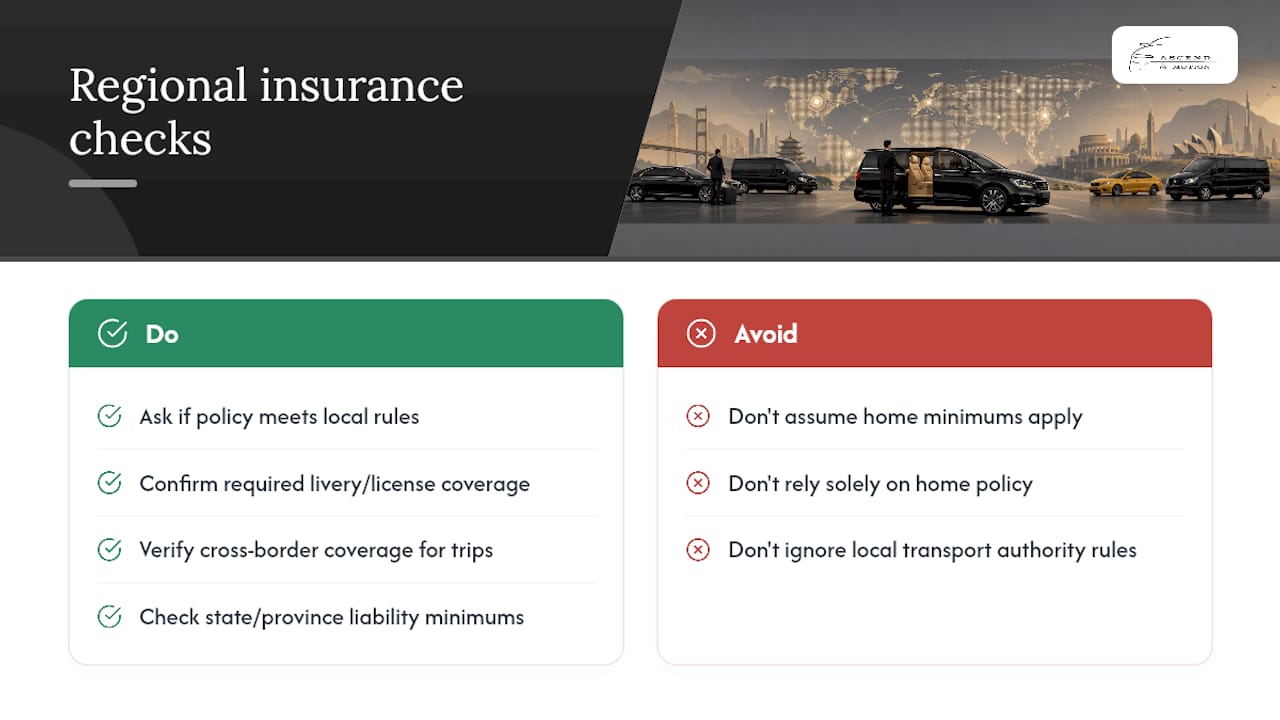
Insurance requirements for chauffeured transport are not uniform. Each country, and often each state or province within it, sets its own minimum liability limits and licensing rules for commercial passenger vehicles.
In the United States, requirements vary by state: some states mandate specific minimum liability coverage for livery or for-hire vehicles, while others leave more discretion to local transportation authorities. California, for instance, applies its own commercial passenger carrier rules on top of standard auto liability minimums, which is one reason California car service standards look different from requirements in a neighboring state.
Outside the United States, the picture shifts again. Some countries require operators to hold a specific for-hire or private hire license tied to their insurance, while others fold passenger transport coverage into broader commercial vehicle regulations. A chauffeur service operating across borders, say a trip that crosses from California toward a neighboring region, needs coverage that satisfies each jurisdiction it touches.
The practical takeaway for travelers: never assume the minimums you’re used to at home apply elsewhere. If you’re booking a chauffeur for international travel, ask specifically whether the operator’s policy meets local requirements for that country or state, not just their home base.
What Happens if You Need to File a Claim?
Filing a claim after an incident in a chauffeured vehicle follows a different path than filing through your own auto policy, mainly because the claim runs through the operator’s commercial insurer, not yours.
The first step is documentation. Note the time, location, and chauffeur’s name, and request an incident report from the company if one exists. Most operators with real commercial coverage have a standard process for this, since it’s part of what their insurer requires to process a claim quickly.
Next, the claim typically routes through the company’s insurance carrier rather than your personal policy, which is one reason passenger liability coverage matters so much at the booking stage. Your own auto insurer usually isn’t involved at all, since you weren’t driving and the vehicle wasn’t yours.
Response times vary by carrier and severity of the incident, but a company that keeps its documentation current, certificates, policy numbers, effective dates, tends to move through claims faster because there’s no scramble to locate basic paperwork. This is exactly why asking for a certificate of insurance before your trip isn’t just a formality. It’s the difference between a smooth claims process and a drawn-out one if you ever need it.
Who Is Liable if Your Chauffeured Vehicle Is in an Accident?
Liability in a chauffeured vehicle accident generally falls on the operator’s commercial insurance, not on you as the passenger, provided the chauffeur was acting within the scope of the job.
If the chauffeur is at fault, the company’s commercial auto liability and passenger liability coverage should address both your injuries and any third-party damage. If another driver caused the crash, your protection depends heavily on whether the operator carries uninsured or underinsured motorist coverage, since that layer is what steps in when the at-fault party’s insurance falls short.
Where things get complicated is when there’s a dispute over fault, or when a policy’s limits are lower than the damages involved. This is precisely why checking policy limits before you book isn’t a bureaucratic formality. A policy with thin limits can leave you exposed even when the operator technically did nothing wrong.
As a passenger, you generally aren’t held legally responsible for the accident itself, but the strength of your outcome, medical costs covered, time lost, resolution speed, depends almost entirely on the coverage the operator had in place before you ever got in the car.
What Frequent Travelers Get Wrong About Insurance
Most travelers treat insurance questions as an afterthought, something to ask about only after a problem occurs. That’s backward. The strongest signal of a well-run chauffeur service isn’t the insurance certificate itself. It’s whether the certificate matches what you see happening operationally: flight tracking that actually adjusts pickup times, a dispatch line that’s answered by a person, and pricing that doesn’t shift once you’re already in the car.
Conventional advice tends to stop at “ask for proof of insurance,” and while that’s necessary, it’s not sufficient. A company can hold a valid policy and still run a sloppy operation where wait-time disputes and communication gaps create real friction. The better question is whether the company’s daily habits, chauffeur vetting, maintenance routines, live flight monitoring, reflect the same seriousness as its paperwork.
If you prioritize one thing, prioritize operational transparency alongside the certificate. A provider willing to show both is telling you something real about how they’ll handle your trip if anything goes sideways.
Book a Chauffeur Service That Backs Its Insurance With Real Operations
Ascendinmotion carries commercial insurance, including passenger liability coverage, and pairs it with the operational habits this article just walked through: live flight monitoring, fixed pricing on airport routes, and chauffeurs who go through background checks and professional training before they’re ever assigned a booking.

Alt text: Black Mercedes-Benz Sprinter chauffeur vehicle parked curbside for an airport pickup.
The fleet runs on black minivans and Mercedes-Benz Sprinters, kept on commercial maintenance schedules, with the Ascendinmotion name appearing only on those service vehicles. Coverage extends to LAX transfers, point-to-point rides to destinations like Disneyland, Universal Studios, and Santa Monica, and longer trips toward Las Vegas or San Diego. Wheelchair-accessible service is not part of the current fleet offering, so travelers with that specific need should confirm alternatives elsewhere.
Ready to book? Reserve your ride and provide your flight number and passenger count directly through the chauffeur booking page, and you’ll get a confirmed vehicle, a named chauffeur, and a fixed rate before you ever step off the plane.

