
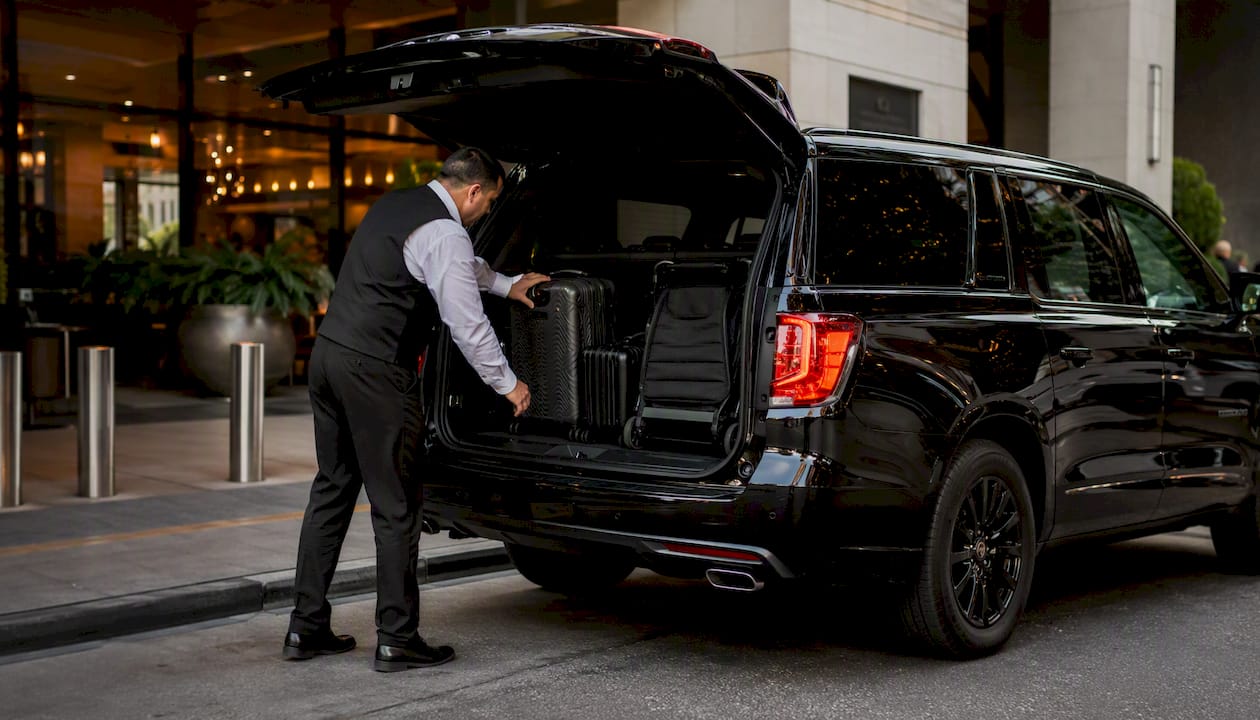
A chauffeur-class SUV comfortably seats 3 to 5 passengers once you account for luggage, with 6 possible only in specific layouts. If your group hits 5 or more people, or you’re checking more than 4 large suitcases, move up to a mini van or Sprinter. Ascend in Motion’s fleet—the First Class SUV, Mini Van, and LAX Sprinter Van—covers that entire range.
TL;DR:
- SUVs typically accommodate only 3 to 5 passengers comfortably once luggage and gear are factored in, not the manufacturer’s maximum seat count.
- Heavy luggage often reduces usable seating space to the point that larger groups or additional gear require moving up to a mini van or Sprinter van.
- It is crucial to specify luggage count, seating layout, and gear needs during booking to ensure vehicle capacity matches actual trip requirements.
- Crossing the threshold of 4 large suitcases or oversized gear usually makes a mini van or Sprinter the practical choice over an SUV.
- Ascend in Motion’s fleet simplifies sizing by providing detailed luggage capacities and real-time flight monitoring, reducing booking surprises.
Table of Contents
- How Many Passengers Actually Fit in an SUV?
- What Should You Ask Before Booking?
- When Does Luggage Take Over the Back Seat?
- Why Ascend in Motion Makes Sizing Simple
- Dispatcher’s Note: How We Actually Size Vehicles
- Quick Reference Links
- Sources
How Many Passengers Actually Fit in an SUV?
Manufacturer specs say a full-size luxury SUV seats up to 6 or 7. Booking reality says something different. Once you load two or three checked bags, a stroller, or golf clubs, that third-row seat stops being usable space and starts being cargo overflow. Chauffeur operators comparing SUVs to Sprinters consistently land on the same number: 3 to 5 passengers is the realistic, comfortable count for an SUV once bags enter the equation.
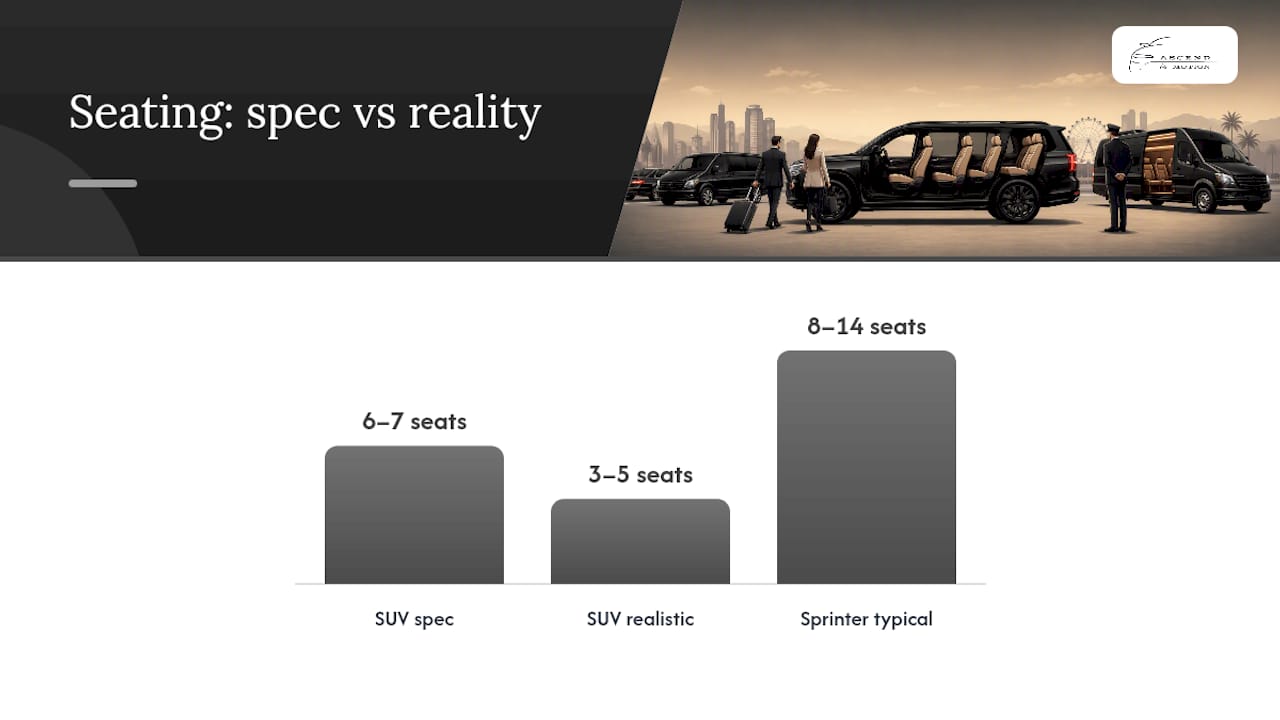
That gap between the sticker seating capacity and the usable seating capacity is a common source of surprise at curbside pickup. For example, some families might book an SUV because it lists seats for six, then find insufficient space for luggage and additional items. Sizing a vehicle by passenger capacity alone, without considering gear, can lead to booking issues.
Below, the comparison breaks down what each Ascend in Motion vehicle class actually handles for real trips, not brochure numbers.
| Vehicle | Typical seating (passengers) | Usable luggage capacity | Best for | Standout feature |
|---|---|---|---|---|
| First Class SUV (Ascend in Motion) | 3–5 | 3–4 large suitcases | 1–4 passengers with light to moderate luggage; executive airport transfers | Discreet executive cabin and curb agility |
| Mini Van (Ascend in Motion) | 5–8 | 5–7 large suitcases | Families or small groups with moderate to heavy luggage | Extra middle seating without losing cargo room |
| LAX Sprinter Van (Ascend in Motion) | 7–14 | 8+ large suitcases | Larger groups, corporate teams, or trips with bulky gear | Walk-through cabin with dedicated luggage space |
The pattern across every row is the same: luggage capacity shrinks usable seating capacity, not the other way around. Sprinter vans commonly seat 8 to 14 depending on configuration, and that extra cargo room is exactly why they become the default once a group crosses six people or brings heavy gear. If you’re comparing SUV vs van for family trips with kids, strollers, and beach gear, the van usually wins on room alone, even when the headcount would technically fit an SUV.
What Should You Ask Before Booking?
Getting the right vehicle isn’t about guessing. It’s about asking three questions before you confirm the reservation, because a mismatch discovered at the curb is much harder to fix than one caught during booking.
- Confirm the exact seating layout. Ask whether the third row (if any) is counted as usable seating or reserved for overflow luggage.
- State your luggage count up front. Give the number of checked bags, carry-ons, and any oversized items like golf bags or ski equipment.
- Disclose car seat needs early. Chauffeur services need lead time to install child seats correctly, and this can also affect how many adults fit comfortably.
- Verify curb and pickup constraints. Airport curbs, hotel driveways, and event venues sometimes restrict larger vehicles like Sprinters.
- Get seating and luggage in writing. A confirmed reservation should state vehicle class and expected luggage handling, not just passenger count.
Refuse any booking that leaves these vague. A dispatcher should be able to size your trip using three thresholds: passenger count, luggage count, and gear profile. Crossing any one of them is the trigger to move up a vehicle class. If a provider can’t answer how many large suitcases fit in their SUV, or won’t confirm the seating layout in writing, that’s a red flag worth walking away from.
Pro Tip: Book your vehicle class based on your heaviest travel day, not your average one. If day one is a light hotel transfer but day three involves an airport run with six suitcases, book for day three.
When Does Luggage Take Over the Back Seat?
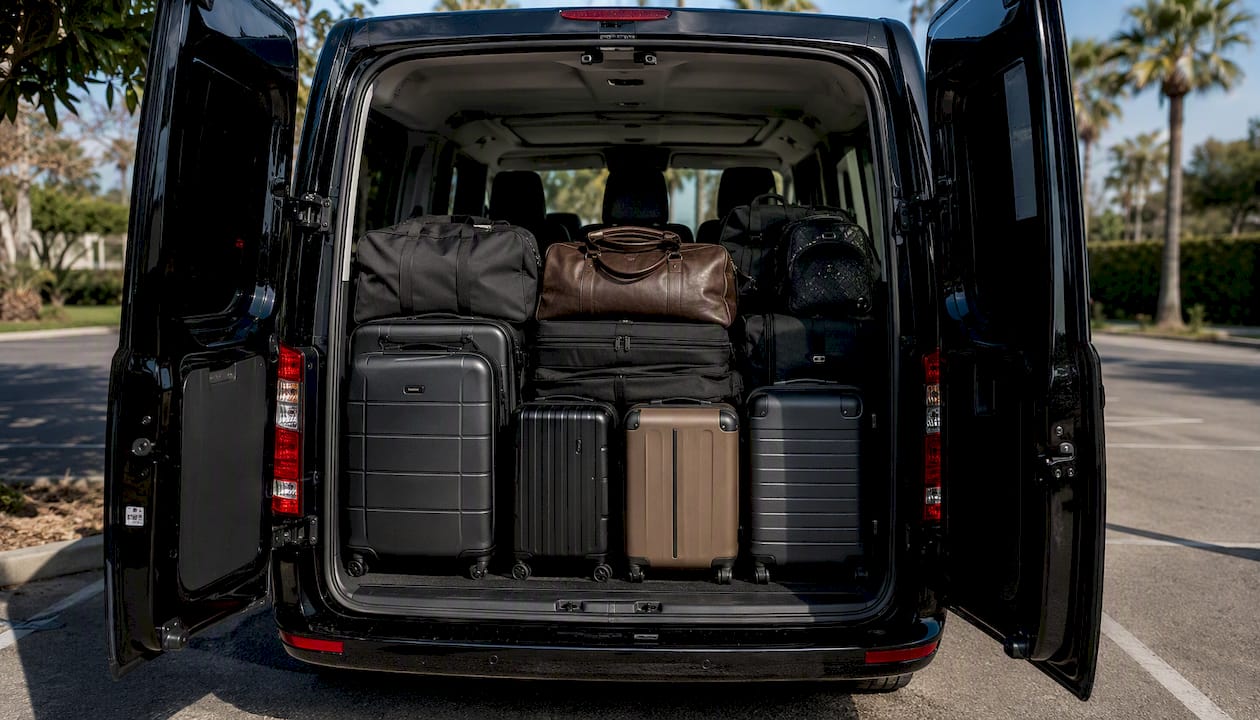
Seating capacity for SUV bookings looks fine on paper until real luggage shows up. A third-row seat plus three checked bags is often the tipping point where an SUV goes from comfortable to cramped, and one oversized item, like a large duffel or a hard-shell golf case, can push the whole booking into Sprinter territory.
A few real scenarios show how fast this shifts:
- A family of four with four checked bags fits an SUV, but barely. Add a stroller and the trunk space runs out.
- Six colleagues traveling with laptop bags and roller carry-ons usually need a mini van, even though six people alone might squeeze into some SUVs.
- Four passengers with golf bags almost always need extra cargo space that a standard SUV trunk can’t provide.
Luggage capacity, not seat count, is the most common reason an SUV fails as an airport transfer, since many SUVs handle only 3 to 6 large suitcases depending on how much of the back row gets used for bags instead of people. If your gear list looks unusual, mention it when booking so the dispatcher can allocate dedicated cargo space or route you toward the mini van instead.
Why Ascend in Motion Makes Sizing Simple
Guessing at vehicle size is the easiest way to end up stuck at curbside with too many bags and not enough seats. Ascend in Motion removes that guesswork with a fleet built around real trip needs, not just brochure seat counts.
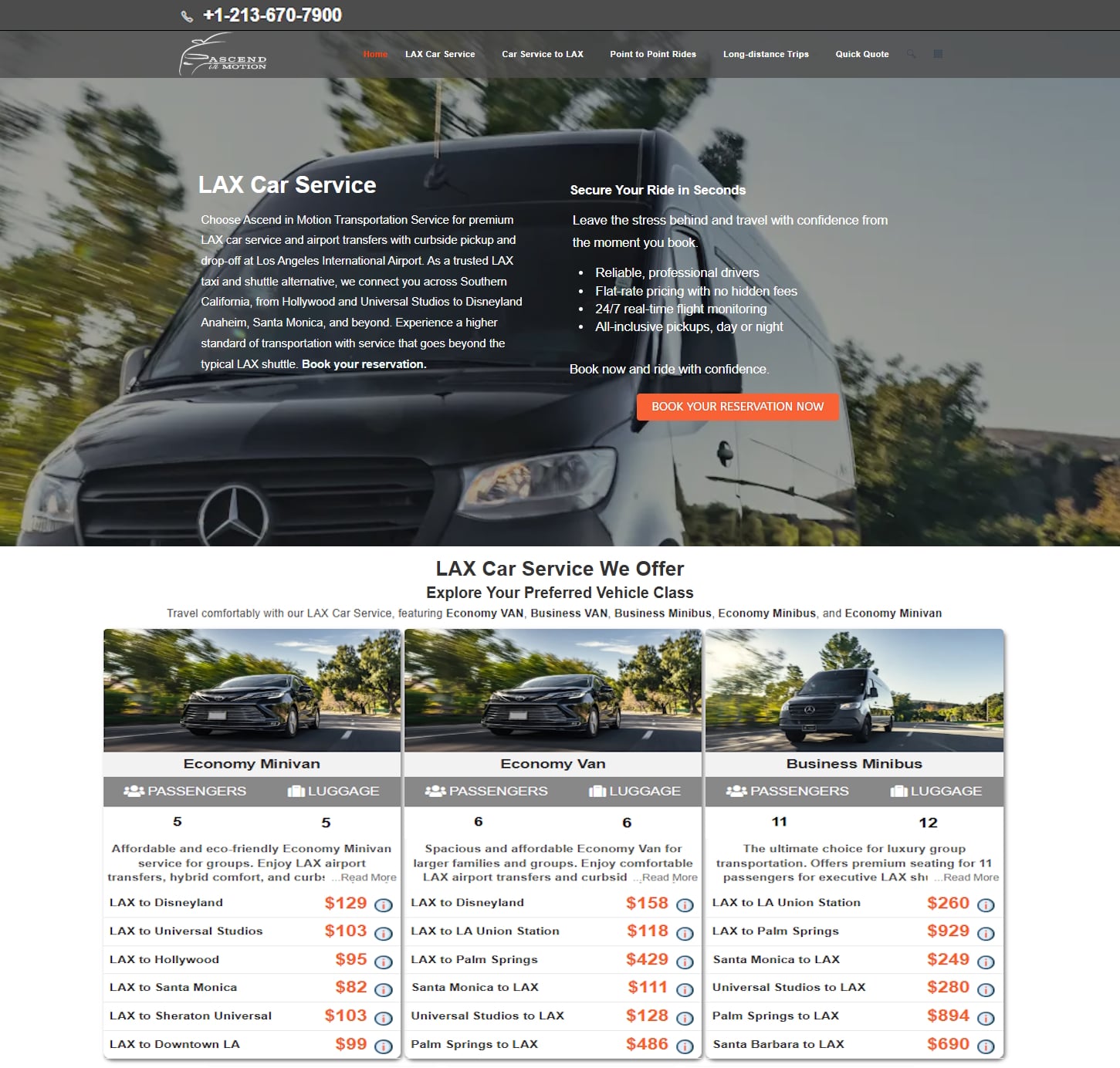
The fleet page lays out exactly what each class offers, from the First Class SUV for executive transfers to the LAX Sprinter Van for larger groups. Alongside it, the luggage limit guide breaks down vehicle-by-vehicle bag capacity so you’re not left estimating. Every booking includes real-time flight monitoring for airport pickups and flat-rate pricing, so the number on your confirmation is the number you pay, regardless of traffic or a late flight. For larger groups needing more than a Sprinter, the business minibus option extends capacity further.
Ready to lock in the right vehicle for your group? Book your chauffeur online and confirm your seating and luggage details before pickup day.
Dispatcher’s Note: How We Actually Size Vehicles
When a booking sits right on the edge of a passenger or luggage threshold, we size up rather than hope it works out. A group of five with three golf bags looks fine on a seating chart and falls apart the moment the trunk closes. That’s the rule: if luggage or gear is borderline, move to the bigger vehicle before the trip, not during it.
Two SUVs can substitute for one Sprinter when a group wants privacy or a split pickup, but it comes with real tradeoffs: two chauffeurs, two staging plans, and a coordination burden that a single Sprinter simply doesn’t have. For groups that value arriving together, one cabin usually beats two cars timed to meet at the same curb. And every service vehicle in our fleet, whether it’s a black mini van or a Mercedes-Benz Sprinter, carries the Ascend in Motion name. Nothing else does.
— Sirus
Quick Reference Links
Check the fleet overview and luggage limit guide before booking. Planning a multi-stop event? See this event transportation guide for coordination tips.
Sources
- Sprinter Van vs SUV NYC: Which Is Better for Your Group? | Iona Sprinter
- PDX Vehicle Selection Guide | Sedan, SUV, or Sprinter

