
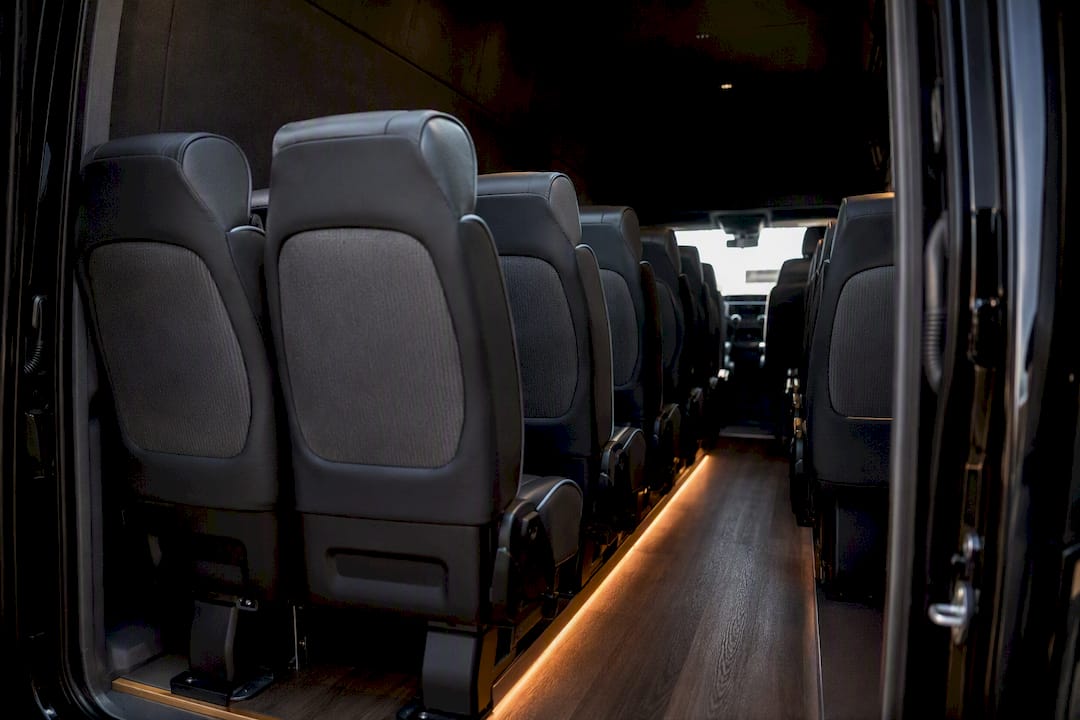
Sprinter van capacity swings widely by model: cargo variants haul payloads from roughly 3,000 pounds up to more than 6,800 pounds on heavy-duty trims, while passenger builds seat 12 to 15 people. Crew configurations split the difference, carrying up to five people plus gear. The number that actually matters, though, is not the brochure figure. It’s the GVWR minus curb weight on your specific van, after options.
TL;DR:
- Payload ratings vary significantly between cargo and passenger configurations, with heavy-duty trims reaching over 6,800 pounds in payload capacity.
- The actual usable payload depends on the specific van’s curb weight, which can increase with options like all-wheel drive or roof racks, reducing capacity.
- Luggage capacity for a 12- to 15-passenger van typically ranges from 8 to 15 suitcases depending on roof height and seat arrangement, not just cubic footage.
- Adding internal modifications or equipment reduces payload, and owners should always reweigh after upfitting to confirm the remaining load capacity.
- For group transportation, booking services automatically match the right van size to passenger and luggage counts, eliminating the need for manual payload calculations.
Table of Contents
- What Is Sprinter Van Capacity, Exactly?
- Sprinter Van Capacity at a Glance
- How Sprinter Payload Is Actually Calculated
- Capacities by Configuration: Cargo, Crew, or Passenger
- Real-World Luggage Examples: How Many Bags Actually Fit
- How Upfits and Modifications Eat Into Payload
- Choosing the Right Sprinter for Your Needs
- Ascend in Motion’s Take on Sprinter Capacity and Luggage
- Book a Sprinter Transfer Instead of Managing Capacity Yourself
- Sources
What Is Sprinter Van Capacity, Exactly?
“Capacity” gets used loosely, and that’s where buyers get tripped up. A Sprinter has at least three separate numbers that all get called “capacity”: how much weight it can legally carry (payload), how many people fit in the seats (seating capacity), and how much physical space is inside the box (cargo volume, measured in cubic feet). These numbers do not move together. A high-roof cargo van might have more cubic feet than a smaller one but a lower payload rating, because the taller body adds weight before you load a single box.
Mercedes-Benz sells the Sprinter in three broad families: the Cargo Van, the Crew Van, and the Passenger Van. Each comes in multiple wheelbases, roof heights, and gross vehicle weight classes labeled 2500, 3500, and 4500. That naming convention roughly tracks weight class, not seating, which is the first thing that confuses first-time buyers cross-shopping a Sprinter van vs SUV or a van vs minibus for group transport.
Sprinter Van Capacity at a Glance
Here’s how the major configurations stack up on payload, seats, and interior volume. These figures come from manufacturer specification pages and reflect base configurations; options and upfits change the actual numbers on any individual van.
| Configuration | Typical Seating | Payload Range (lbs) | Cargo Volume (cu ft) |
|---|---|---|---|
| Cargo Van 2500 | 2–3 | Around 4,211 on many trims | Up to roughly 533 (high roof, extended) |
| Cargo Van 3500/4500 | 2–3 | 3,000 to 6,812 depending on trim | Similar footprint, heavier-duty axles |
| Crew Van | Up to 5 | Generally in the 3,000–5,000 range depending on trim | Reduced behind the second row |
| Passenger Van (12–15 seat) | 12–15 | Roughly 3,020–3,307 on many trims | Minimal rear cargo once seats are installed |
The single highest payload numbers show up on the heavy-duty cargo variants, where certain 3500 and 4500 configurations post figures near 6,812 pounds. That’s more than double what you’d get from a comparable 2500 passenger build. If pure hauling weight is the priority, the cargo line wins outright.
Passenger vans tell a different story. Once Mercedes-Benz builds in 12 to 15 seats, plus the structural reinforcement, seat mounts, and interior trim that come with a passenger interior, the remaining payload drops into the 3,020 to 3,307 pound band on many trims. That number has to cover every rider, their luggage, and the driver, all at once. Independent reviews confirm this same pattern of tradeoffs across the lineup, noting that payload figures shift meaningfully between cargo and passenger builds even when the underlying chassis is similar.
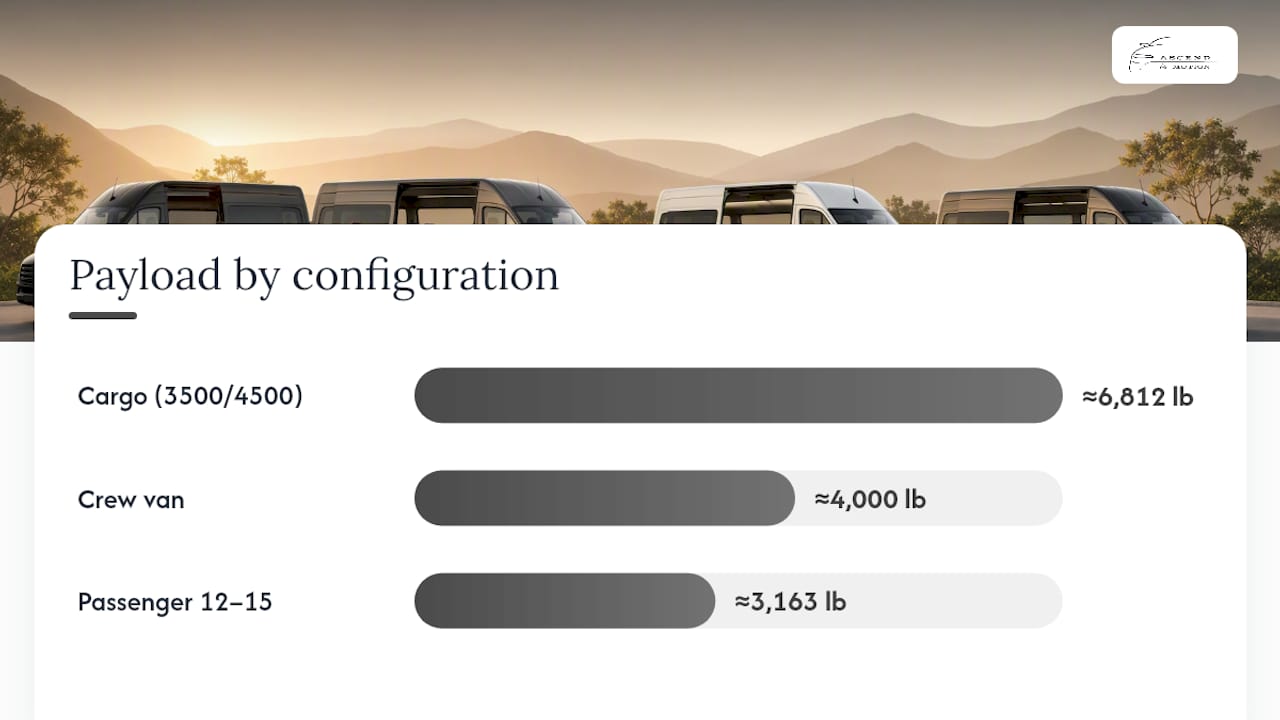
Crew vans sit in the middle. They keep a cargo area behind a second or third row of seats, so you get somewhere between two and five seating positions with meaningful room left for tools, luggage, or freight. It’s the configuration most trades and shuttle operators default to when they need people and gear moving together, but not fifteen people at once.
How Sprinter Payload Is Actually Calculated
Payload isn’t a number Mercedes-Benz pulls out of thin air. It comes from simple subtraction, and once you know the formula, you can sanity-check any dealer’s claim yourself.
- Start with GVWR (Gross Vehicle Weight Rating): the maximum total weight the van, fully loaded, is legally and structurally allowed to weigh.
- Subtract curb weight: the van’s weight as it sits empty, with a full tank of fuel and all standard equipment, but no passengers or cargo.
- What’s left is payload: the pounds you can add before hitting GVWR.
So if a Sprinter 2500 Cargo Van carries a GVWR of roughly 9,050 pounds and a curb weight around 4,839 pounds, the math lands close to the 4,211-pound payload figure Mercedes-Benz publishes for that trim. Every pound of passengers, tools, luggage, and aftermarket equipment comes out of that remaining figure.
Pro Tip: Fuel alone can eat 150 to 200 pounds of your payload on a full tank. If your van is loaded near its limit, top off the tank after weighing cargo, not before, so you don’t accidentally push past GVWR.
Options move this number too. All-wheel drive, dual rear wheels, upgraded suspension, and factory partitions all add curb weight before you load anything. GCWR (Gross Combined Weight Rating) matters separately if you’re towing. That figure covers the van plus a trailer, and it’s a different number from GVWR entirely. A van rated well for payload can still be a poor towing match if GCWR is tight, so check both when a job involves a trailer.
Capacities by Configuration: Cargo, Crew, or Passenger
Matching the right Sprinter family to your job starts with being honest about what you’re actually moving.
Cargo vans exist for freight, tools, and conversions, not people. Interior volume runs up to around 533 cubic feet on a high-roof, extended-wheelbase build, and payloads on the higher trims clear 6,000 pounds. Trades crews, delivery fleets, and camper-van converters gravitate here because the open box behind the front seats can be shelved, racked, or fitted with a raised floor without fighting around seat mounts. For a business shuttling gear and one or two staff rather than groups, a dedicated business van layout tends to outperform a passenger build on usable loading space, even when the advertised cubic footage looks similar on paper.
Crew vans split the interior between a small passenger area and a walled-off cargo section. You get up to five seats up front, with a bulkhead separating riders from equipment in back. Payload numbers here vary more than in the cargo or passenger lines because crew builds mix so many options, but plan on somewhere in the 3,000 to 5,000 pound range depending on trim and wheelbase.
Passenger vans are built around people first. The 12 seat and 15 seat layouts are the two you’ll see most often, and the choice between them is really a choice about luggage space. A 12 seat configuration leaves a rear bay for bags. A 15 seat configuration fills nearly every row, leaving minimal room behind the last bench.
Wheelbase and roof height change the equation further:
- 144-inch wheelbase, standard roof: the most compact option, easiest to park, least interior volume.
- 170-inch wheelbase, high roof: the largest common configuration, maximizing both standing height and cargo room behind the seats.
- High-roof variants add usable stacking height but can shift curb weight enough to slightly change published payload figures versus a standard-roof van in the same trim.
Real-World Luggage Examples: How Many Bags Actually Fit
Cubic feet and payload numbers don’t mean much until you translate them into suitcases. Operators running airport shuttles and group transfers have worked this out through trial and error, and the pattern holds fairly consistently across the industry.
- A 12-passenger Sprinter with a rear luggage bay typically fits 12 to 15 large checked bags, assuming standard 29 to 32 inch hardside suitcases.
- A 15-passenger layout, with seats filling nearly the whole cabin, usually only accommodates 8 to 12 checked bags, since there’s little dedicated space left behind the final row.
- High-roof, long-wheelbase vans improve stacking options considerably. Bags can go two or three high near the rear doors instead of sitting in a single flat layer, which matters more for total bag count than raw cubic footage alone.
That last point trips people up constantly: two vans with nearly identical published cubic feet can hold noticeably different numbers of bags depending on how tall the roof is and how the rear compartment is shaped. Oddly-shaped items make this worse. Golf bags, garment racks, and oversized suitcases eat disproportionate space compared to their weight, so measuring anything unusual before booking or purchasing saves a headache later. This kind of practical, checked-luggage math is exactly what operator packing guidance is built around, and it’s worth reviewing before assuming a 15-seat van will handle a 15-person trip’s worth of bags without a second vehicle.
How Upfits and Modifications Eat Into Payload
Every pound added after the van leaves the factory comes straight out of payload. Buyers frequently forget this, then get surprised when a “6,800 pound payload” cargo van can’t actually carry 6,800 pounds of tools once it’s built out.
Common upfits and their rough weight impact:
- Shelving and racking systems: often several hundred pounds depending on material and coverage.
- Additional bench seating: each added row, plus mounting hardware, adds weight and permanently changes the interior layout.
- Wheelchair lifts and ramps: among the heaviest common upfits, sometimes running into the hundreds of pounds installed.
- Roof racks and ladder racks: lighter individually, but they add up fast alongside other equipment, and they raise the center of gravity too.
Here’s the part that catches people off guard: removing seats to make room for cargo does not change a van’s GVWR. It only changes how much of that same weight allowance you’re using for people versus gear. The legal, safe payload number only moves when you re-weigh the finished vehicle. A shop that installs 400 pounds of shelving into a van rated for 4,211 pounds of payload has left you with roughly 3,811 pounds to work with, not the original number on the window sticker.
The fix is straightforward: after any upfit, get the finished van weighed and ask for documentation of the new curb weight against the VIN-specific GVWR. Specs published online are a starting point, not a substitute for checking the actual build.

Choosing the Right Sprinter for Your Needs
Buyers and operators who get this right tend to follow the same sequence, in this order:
- Define your actual load first. Count people, count bags, weigh the heaviest equipment you’ll routinely carry. Guessing “we’ll probably be fine” is how vans end up overloaded.
- Shortlist by family and wheelbase. Cargo for freight, crew for mixed loads, passenger for groups. Then pick standard versus high roof and short versus long wheelbase based on the volume you actually need, not the biggest number available.
- Verify curb weight and GVWR on the specific VIN, especially after any upfit. Ask the dealer or upfitter directly for post-modification weight documentation, not just factory literature.
Worth asking any dealer or upfitter directly: What’s the final curb weight after these options? What’s the GVWR and GCWR if I’ll be towing? Does adding this equipment affect the factory warranty? If you’re weighing a Sprinter van vs SUV or minibus for group work rather than ownership, Ascend in Motion’s fleet overview breaks down how seating and cargo tradeoffs play out in real operating conditions, and the luggage limit guide walks through vehicle-by-vehicle bag limits.
Ascend in Motion’s Take on Sprinter Capacity and Luggage
Specification sheets tell you what a Sprinter can carry. They don’t tell you what actually fits comfortably once real bags, real bodies, and real airport curb time enter the picture. Ascend in Motion assigns vehicle layout based on the guest count and luggage profile a trip actually reports, not just headcount. A party of ten with golf clubs and full-size suitcases gets a different van than ten people flying with backpacks.
Oversized or unusual items get flagged and confirmed before pickup rather than discovered at the curb. That’s the gap between a spec sheet and a smooth transfer.
— Sirus
Book a Sprinter Transfer Instead of Managing Capacity Yourself
Working through payload math and luggage counts makes sense if you’re buying or upfitting a Sprinter for your own fleet. If you just need a group moved reliably, Ascend in Motion removes that math entirely. Every booking pairs the right layout to your actual passenger and luggage count in advance, backed by real-time flight monitoring for airport pickups and flat-rate pricing with no surprise fees at the curb.
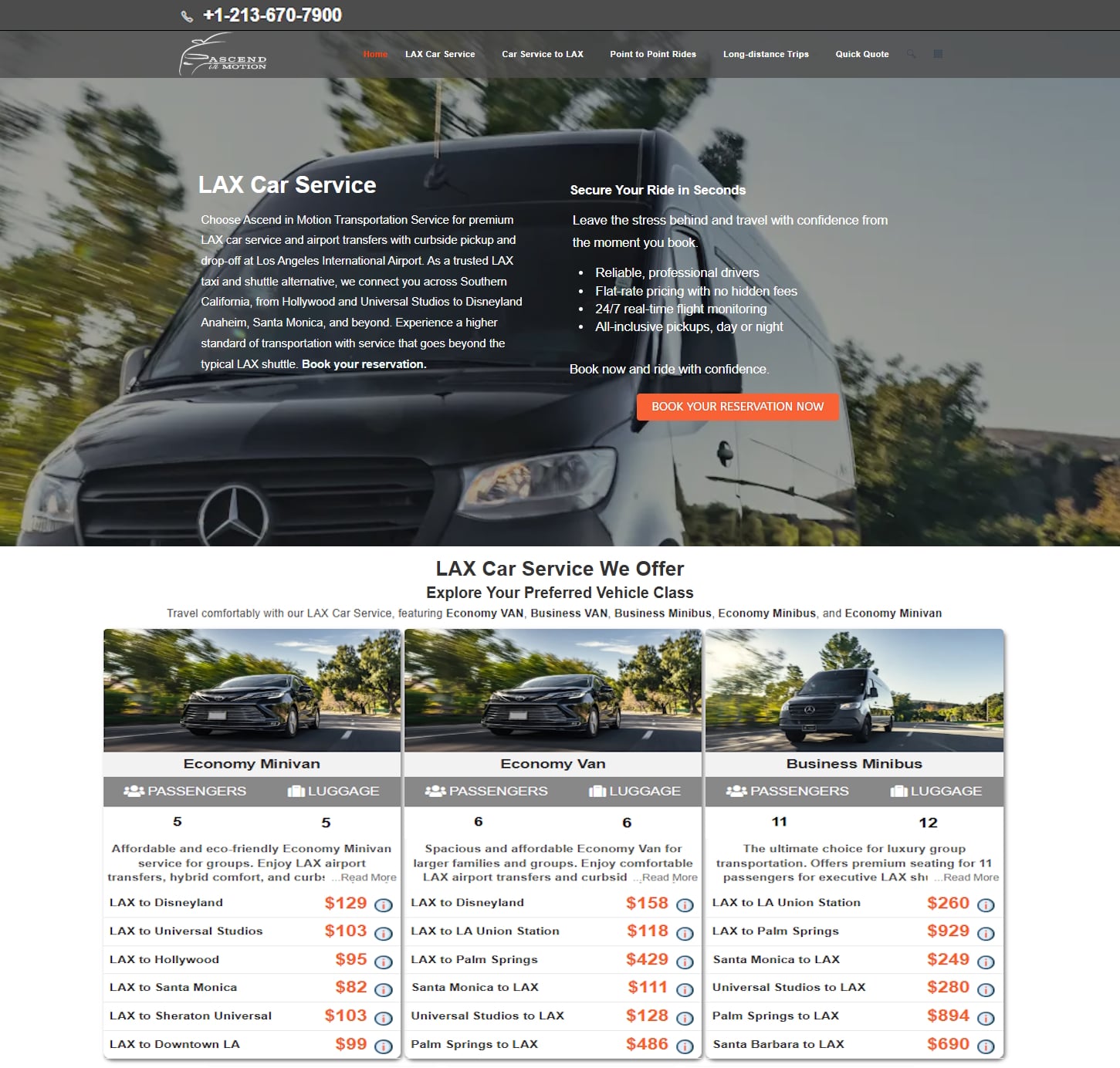
Ascend in Motion runs black Mercedes-Benz Sprinters and minivans across Southern California, from LAX transfers to Disneyland, Universal Studios, and long-distance runs to Las Vegas or Palm Springs. Groups sizing up a Sprinter van vs SUV or minibus for an airport run get a straightforward answer: tell the team your headcount and bag count, and the right vehicle gets assigned before the day of travel. Fleet owners planning routine group hauling should also confirm proper coverage through a resource like commercial freight and liability insurance before putting a van into regular service.
Check availability and get a flat-rate quote through the LAX airport transfer page, or explore Sprinter group transfer service directly if you already know your group size.
Sources
Confirm any figure in this guide against the manufacturer’s current Cargo Van and Passenger Van spec pages, cross-check with Car and Driver’s independent review, and review IIHS safety ratings before finalizing a passenger-carrying build. Always verify curb weight and GVWR against your specific VIN.
- 2026 Cargo Van | Sprinter | Mercedes‑Benz Vans
- 2026 Mercedes‑Benz Sprinter review, pricing, and specs | Car and Driver
- Understanding Sprinter Van Luggage Capacity for Your Transport Needs

