

Renting a car one-way from LA to Vegas typically lands between $80 and $250 in fuel and base rental charges, but drop fees and airport surcharges can push a short rental past $300 before you even leave the lot. The most predictable option is a flat-rate private transfer, since it locks in one price before you travel instead of leaving you to guess at fees. Use the breakdown below to calculate the total for your specific trip.
TL;DR:
- Using a private transfer guarantees the quoted rate includes all fees, avoiding unpredictable surcharges like airport fees or drop charges that can increase rental costs significantly.
- Fuel costs for the 270-mile trip typically range from $32 to $61 depending on vehicle efficiency, with prices fluctuating weekly based on gas rates.
- One-way rental car fees vary widely, with drop charges often exceeding $100 for larger vehicles or during peak demand, making upfront quotes essential.
- Booking off-airport pickup options and avoiding prepaid fuel plans can reduce costs, especially when combined with shopping for discounts or promotions from rental companies.
- Flat-rate private transfer services like Ascend in Motion offer upfront pricing without hidden fees, ideal for groups, late arrivals, or travelers prioritizing cost predictability.
Table of Contents
- At-a-Glance Cost Comparison: One-Way Rental vs Driving vs Private Chauffeur
- Fuel Cost and Mileage Math for the 270-Mile Trip
- Rental Fees and Mandatory Surcharges Explained
- Tactical Ways to Lower Your LA to Vegas Car Cost
- Sample Budget Scenarios With Itemized One-Way Estimates
- When a Private Chauffeur Is Worth the Extra Cost
- Ascend in Motion: A Flat-Rate Alternative for the LA to Vegas Route
- Tools to Verify Your Numbers Before You Book
- Sources
- FAQ
At-a-Glance Cost Comparison: One-Way Rental vs Driving vs Private Chauffeur
Three cost drivers decide what you’ll actually pay on this route: the daily rental rate, the one-way drop fee, and fuel. A fourth factor, airport surcharges, only applies if you pick up at LAX rather than an off-airport location. Add them together and the “cheap” $35-a-day compact car you saw online can quietly become a $250 total.
Here’s how the components stack up depending on which approach you choose:
- Self-drive in your own car: fuel only, roughly $50 to $90 one-way for the 270-mile trip, plus wear and tolls.
- One-way rental car: daily rate plus a drop fee that varies by vehicle class, plus fuel, plus airport fees if picked up at LAX.
- Private chauffeur transfer: a single flat rate quoted before travel, covering the vehicle, driver, and fuel with no surprise line items at drop-off.
The tradeoff is predictability. A rental quote you see on an aggregator like Expedia often shows a tempting base price, but the fees get added at checkout, not on the search results page. A flat-rate transfer strips that uncertainty out entirely, since the number you’re quoted is the number you pay. For a solo traveler on a tight budget, self-driving your own car is usually cheapest. For groups, families with luggage, or anyone who values knowing the final cost in advance, a chauffeur service or a well-negotiated one-way rental tends to make more financial sense once you account for parking, tolls, and time.
Whichever route you pick, treat the first quote as a starting point, not the final number. Verify the full price breakdown before you book.
Fuel Cost and Mileage Math for the 270-Mile Trip
The drive from Los Angeles to Las Vegas covers about 270 miles via I-15, according to Google Maps, and that distance is the backbone of any fuel estimate. The formula is simple: Fuel Cost equals Trip Distance divided by Highway MPG, multiplied by the current price per gallon.
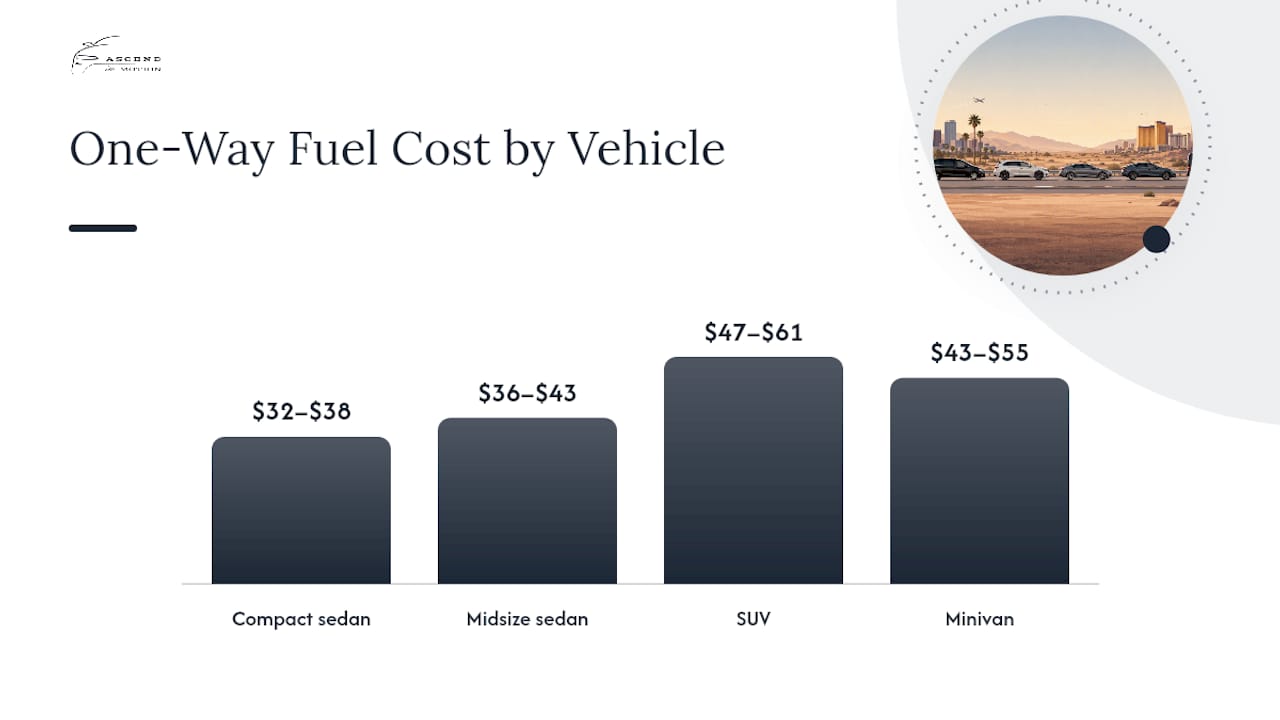
Say your car gets 30 highway MPG and gas runs an average price a gallon. That’s 270 divided by 30, which is 9 gallons, times that average price, resulting in a fuel cost around forty dollars one-way. Swap in a less efficient SUV at 22 MPG and the same math produces roughly $55.
Pro Tip: Fill up in Los Angeles before you leave and again in Primm or Jean, Nevada, where gas prices typically run lower than the stations scattered through the desert stretch in between.
| Vehicle Type | Typical Highway MPG | Estimated One-Way Fuel Cost |
|---|---|---|
| Compact sedan | 32 to 38 | $32 to $38 |
| Midsize sedan | 28 to 34 | $36 to $43 |
| SUV | 20 to 26 | $47 to $61 |
| Minivan | 22 to 28 | $43 to $55 |
Fuel costs for the trip typically run $50 to $90 one-way depending on your vehicle’s efficiency and current pump prices. TravelMath’s driving-cost calculator pegs a standard one-way estimate at around $56.49, a useful cross-check if your own math lands in a similar range. Gas prices fluctuate week to week, so run the formula again a few days before you leave rather than relying on a number from last month.
Rental Fees and Mandatory Surcharges Explained
The daily rate you see advertised is rarely what you pay. Several add-on fees stack on top of it, and understanding each one helps you spot which are avoidable and which aren’t.
The one-way or drop fee is the biggest variable. Rental companies charge it because returning a car to a different city than where it was picked up means someone has to drive it back, and that cost gets passed to you. The fee isn’t a flat penalty. It’s tied to logistics, and it shifts based on vehicle class and how badly the company needs cars repositioned. SUVs and specialty vehicles often carry higher repositioning charges than compact sedans.
Beyond that, expect to see:
- Airport concession recovery fee (ACRF): a charge airport-based rental counters pass on to cover what they pay the airport for operating there.
- Customer facility charge (CFC): a flat daily fee tied to the airport’s rental facility.
- Vehicle license fee (VLF) and taxes: state and local charges added to nearly every rental.
- Insurance and young-driver surcharges: optional coverage or age-based fees, often the most negotiable line items.
- Tolls and parking: not part of the rental agreement, but real costs once you’re on I-15 or parked at a Vegas hotel.
Pro Tip: Skip the prepaid fuel option at pickup. It’s almost always priced above what you’d pay refilling the tank yourself right before drop-off.
Before you enter payment information, ask the counter agent (or check the online checkout screen) for a full itemized total, not just the daily rate. That single step catches most of the surprises.
Tactical Ways to Lower Your LA to Vegas Car Cost
A few deliberate choices can shave real money off your total, and most take less than five minutes to check.
- Compare off-airport pickup against a rideshare fare. Picking up in Santa Monica or Culver City instead of LAX often avoids the ACRF and CFC entirely. Weigh that savings against the cost of a short rideshare to reach the off-airport location.
- Check the rental company’s “Deals” or “Offers” page before booking. One-way fees are set dynamically based on fleet needs, so companies sometimes waive or reduce them when they need cars moved to Las Vegas anyway.
- Refuel near the return location, not at the counter. Prepaid fuel plans carry a markup; a self-serve fill-up close to drop-off is consistently cheaper.
- Check your credit card or personal auto policy for rental coverage. You may already be covered, which lets you skip the counter’s insurance upsell.
- Get the full breakdown in writing before you pay. Ask for taxes, surcharges, and the one-way fee itemized separately so nothing shows up as a surprise at drop-off.
Pro Tip: Run the numbers twice, once with a low estimated one-way fee and once with a high one, so you know the realistic spread before you commit to a reservation.
Sample Budget Scenarios With Itemized One-Way Estimates
Real numbers help more than averages, so here’s how a handful of common trip types typically shake out.
- Economy solo traveler: a compact sedan at roughly $35 to $60 in fuel, plus a one-way fee that can range from modest to well over $100 depending on the company and timing.
- Midsize family with luggage: stepping up to a midsize or small SUV pushes fuel to around $45 to $60, and the larger vehicle class often carries a higher drop fee than a compact.
- Group or van booking: a minivan or full-size SUV runs $45 to $55 in fuel, but split five or six ways, the per-person cost of a private group transfer can end up competitive with individual rental shares once you add parking and surcharges.
- Self-drive, fuel-only: if you’re taking your own car, budget purely on the fuel formula above, roughly $50 to $90 one-way with no rental fees at all.
The common thread across every scenario is that fuel is the one predictable number. Everything else, the one-way fee, the surcharges, the insurance upsell, moves depending on the company, the day you book, and the vehicle class. That’s precisely why a flat-rate quote appeals to travelers who’d rather know the total before they leave home than calculate it after.
When a Private Chauffeur Is Worth the Extra Cost
Private transfers make the most sense for groups splitting costs, corporate travelers who need a reliable pickup, late-night arrivals when you don’t want to hunt for a rental counter, or anyone hauling enough luggage that trunk space becomes a real concern. In each case, the flat rate replaces a pile of variables with one number decided in advance.
Before booking any private transfer, confirm the quote covers your exact pickup and drop-off points, includes all fees with nothing added later, and accounts for your group size and luggage. A flight-monitoring feature also matters if you’re arriving into LAX and timing a pickup around baggage claim.
— Sirus
Ascend in Motion: A Flat-Rate Alternative for the LA to Vegas Route
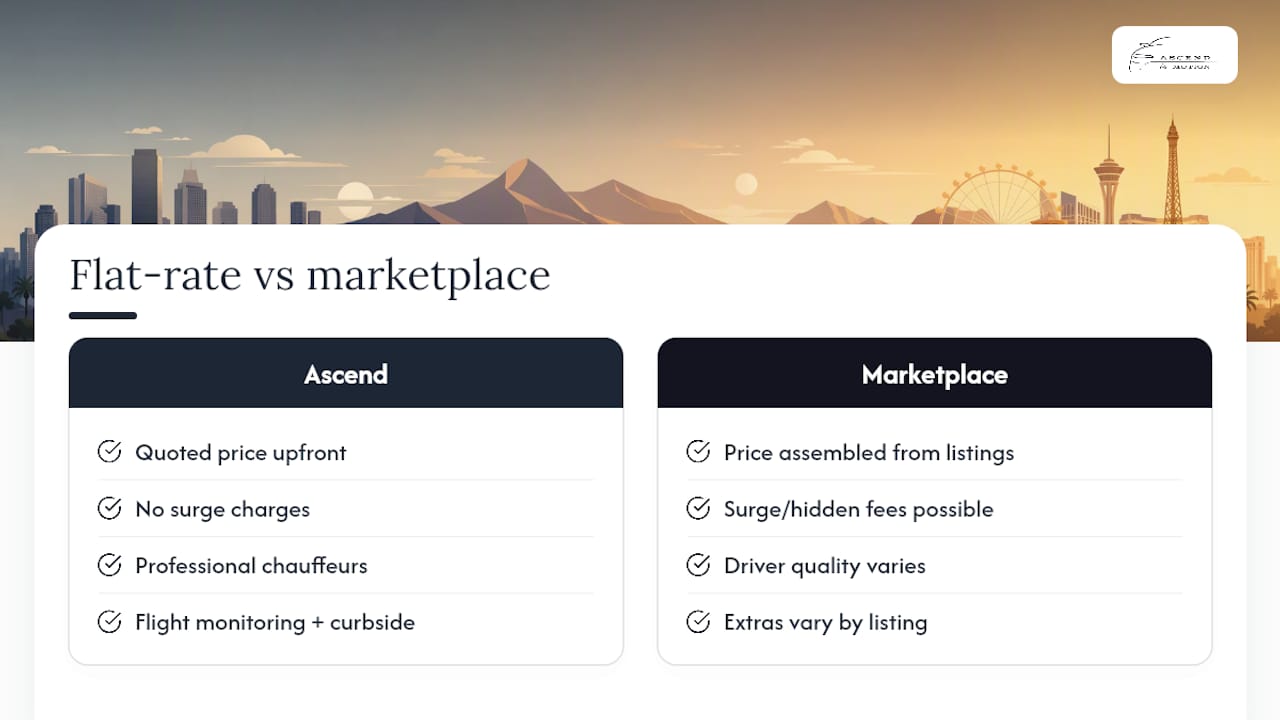
If the fee math above left you wanting a simpler answer, that’s exactly the gap Ascend in Motion fills. The service offers transparent flat-rate pricing with no surge charges for LA to Vegas transfers, so the number you’re quoted upfront is the number on your receipt, with no hidden fees added later.
The service runs on professional chauffeurs, real-time flight monitoring for airport pickups, curbside service, and a choice of luxury SUVs, vans, or minibuses depending on your group size. Service vehicles are black minivans or Mercedes-Benz Sprinters, built for comfort on a 270-mile highway run rather than a compact rental sedan.
Because pricing is quoted directly rather than assembled from marketplace listings, check the current flat rate on Ascendinmotion’s long-distance trips page or explore point-to-point service for a straightforward quote before your travel date. Confirm the rate covers your full pickup and drop-off route, then book directly to lock in your price.
Tools to Verify Your Numbers Before You Book
Cross-check your fuel math with TravelMath’s driving-cost calculator or the LA to Vegas gas cost tool, confirm your route distance on Google Maps, and if you’re weighing vehicle shipping instead of driving, AAA Movers’ auto transport page covers that alternative.
Sources
- Los Angeles to Las Vegas Gas Cost Calculator (2026): Estimate Your Trip Cost
- Cost of Driving from Los Angeles, CA to Las Vegas, NV
- Guide to a One-Way Car Rental to Las Vegas
FAQ
Is It Cheaper to Fly or Drive to Vegas From LA?
Driving is usually cheaper for one or two people once you factor in airport parking, TSA lines, and the cost of a rental or rideshare on the Vegas end. For fuel alone, budget $50 to $90 one-way, which typically beats a round-trip flight plus ground transportation for a solo traveler.
Is $1,000 Enough for 3 Days in Vegas?
Yes, for most travelers, a budget covering transportation, a mid-range hotel, meals, and some entertainment over three days is achievable, though it depends heavily on your hotel choice and gaming budget. Transportation should be one of your smaller line items if you budget $50 to $90 for fuel or lock in a flat-rate transfer in advance.
How Much Is an Uber From LA to Vegas?
Rideshare pricing for a 270-mile trip fluctuates with demand and surge pricing, and it’s rarely cost-effective for a group compared to a rental or private transfer. For predictable pricing on the same route, a flat-rate service like Ascendinmotion’s long-distance transfers quotes the total before you travel instead of calculating it live based on demand.
Is the Drive From LA to Las Vegas Worth It?
Most travelers find the drive worth it for the flexibility, since you control your schedule and avoid airport security lines for a trip under five hours. The 270-mile route via I-15 is straightforward, and the main decision is simply choosing the vehicle and cost structure that fits your budget and group size.
What Does Ascend in Motion Charge for LA to Vegas?
Current flat-rate pricing for the LA to Vegas route is listed directly on Ascendinmotion’s long-distance trips page, where you can get an exact quote for your travel date and vehicle preference.

