

TL;DR:
- Taxi services are demand-responsive transportation with licensed drivers, charging fares based on distance or time. They differ from public transit by offering flexible destinations, routes, and booking methods, including street hails, dispatch, and app-based booking. Regulations, licensing, fare structures, and accessibility rules shape the experience, especially at airports where fixed fares and permits are common.
A taxi service is defined as paid, demand-responsive passenger transport where a licensed driver carries passengers to destinations controlled by the rider, not over fixed routes or schedules. Unlike a city bus or subway, a cab service responds to your request, goes where you need to go, and charges based on distance or time. Travelers researching airport transfers, local rides, or urban transportation options need to understand how taxi services work, what types exist, and how regulations shape the experience before they book.
What is a taxi service and how does it differ from public transit?
A taxi service, also called a cab service, belongs to the broader category of for-hire ground transportation. The industry classification NAICS 485310 covers traditional taxi owner-operators, ridesharing services, and ride-hailing platforms under one umbrella. That grouping reflects a key truth: the defining feature of a taxi service is its demand-responsive nature, not the type of vehicle.

Public transit runs on fixed schedules and fixed stops. A taxi service does neither. You control the destination, the departure time, and often the route. That flexibility is the core value proposition for airport travelers, late-night commuters, and anyone whose schedule does not fit a bus timetable.
Taxi drivers can operate independently, as part of a fleet, or through taxi associations with unified branding. Associations coordinate dispatch, maintain consistent pricing, and give passengers a recognizable name to call or book through. That structure directly affects your experience as a rider.
How do taxi services operate in urban areas and airports?
Taxi services use three main operating models: street hailing, phone or radio dispatch, and app-based booking. Each model works differently depending on the city and the situation.
Street hailing works in dense urban areas where licensed taxis display a roof light. When the light is on, the cab is available. You wave it down, state your destination, and the driver accepts. This model is common in New York City and Chicago but rare in suburban or airport-only markets.

Dispatch services connect riders to drivers through a central operator. You call a number, give your location, and a driver is assigned. Many local taxi companies still rely on radio dispatch, especially for airport pickups where timing matters.
App-based booking has changed how most travelers interact with cab services. Platforms like Lyft and Uber operate under the same NAICS 485310 classification as traditional taxis, though their licensing and fare rules differ significantly by city.
Airport taxi services operate under a separate set of rules. Airport taxi dispatch and fare rules are often set by the airport authority, not the city. Fares may be fixed by contract rate rather than taximeter, and drivers must queue in designated staging areas. Passengers who skip the official taxi queue and accept rides from unmarked vehicles risk unregulated pricing and no legal recourse.
- Taxis at airports often use fixed fares to specific zones or destinations
- Drivers must hold airport-specific permits in addition to city taxi licenses
- Staging areas and dispatch windows are managed by airport ground transportation staff
- Metered fares apply in some airports; flat rates apply in others
Pro Tip: Before landing at LAX or any major airport, check the airport’s official ground transportation page to confirm whether taxis use metered or flat-rate fares. That one step prevents fare disputes at the curb.
What regulations and licensing differentiate taxis from other for-hire vehicles?
Regulation is the main differentiator between taxi services and other for-hire vehicle categories. The distinction matters because it affects where a driver can pick you up, how much you pay, and what legal protections you have as a passenger.
In the United Kingdom, taxis can legally ply for hire in licensed zones and accept street hails. Private hire vehicles, by contrast, must always be pre-booked. That legal line does not exist in marketing. A car that looks identical to a taxi may be a private hire vehicle with completely different rules. The same principle applies across most U.S. cities, where Transportation Network Companies (TNCs) like Uber and Lyft operate under private hire or TNC licenses rather than traditional taxi licenses.
| Category | Street hail allowed | Fare type | Licensing body |
|---|---|---|---|
| Traditional taxi | Yes | Taximeter or fixed rate | City or county authority |
| Private hire vehicle (PHV) | No | Contract or fixed rate | City or county authority |
| TNC (rideshare) | No | Algorithm-based surge pricing | State-level TNC license |
| Airport car service | No | Fixed contract rate | Airport authority |
Fare regulation varies by city, which explains why a taxi ride of the same distance costs different amounts in Los Angeles versus San Francisco. Local licensing authorities set maximum fares, approve taximeter calibration, and determine where taxis can legally operate.
Accessibility rules add another layer. Under 49 C.F.R. § 37.29, U.S. taxi providers cannot refuse service or charge extra fees to riders with disabilities who can use the available vehicles. Taxi fleets are not required to make every vehicle wheelchair accessible, but they cannot discriminate against riders who can board standard vehicles with mobility equipment.
Pro Tip: If a taxi driver refuses to load your folding wheelchair or charges you extra for it, that is a federal violation. Document the cab number and report it to the local licensing authority.
What types of taxi services are available?
Taxi services have expanded well beyond the yellow cab. Travelers in 2026 can choose from several distinct service types, each with different pricing, vehicle standards, and booking methods.
| Service type | Booking method | Fare structure | Best for |
|---|---|---|---|
| Traditional taxi | Street hail or phone | Taximeter | Short urban trips |
| Ride-hailing app | App only | Algorithm-based | Flexible city travel |
| Executive or luxury taxi | Pre-book only | Fixed or contract rate | Business and airport travel |
| Green or eco-friendly taxi | App or phone | Taximeter or fixed | Eco-conscious travelers |
| Airport transfer service | Pre-book only | Fixed contract rate | LAX, JFK, O’Hare pickups |
Traditional taxis offer immediate availability in dense cities. The tradeoff is that pricing can be unpredictable during peak hours or bad weather. Ride-hailing apps provide price transparency upfront but apply surge pricing during high demand. That surge can make a short LAX ride cost more than a pre-booked flat-rate transfer.
Luxury and executive taxi services, including luxury taxi hire in Los Angeles, operate with professional chauffeurs, fixed rates, and higher vehicle standards. These services suit corporate travelers and airport passengers who need punctuality and a specific vehicle class.
- Traditional taxis: best for spontaneous, short urban trips
- Ride-hailing apps: best for price-transparent, flexible city travel
- Luxury car services: best for airport transfers, business travel, and group rides
- Green taxis: best for travelers prioritizing lower emissions
What are the benefits and considerations when choosing a taxi service?
The benefits of taxi services depend heavily on which type you choose and where you are traveling. Understanding the tradeoffs helps you pick the right option for each trip.
Benefits of traditional and regulated taxi services:
- Regulated fares protect against price gouging during peak demand
- Licensed drivers carry verified credentials and pass background checks
- Street hailing provides immediate access without app dependency
- Drivers often know local routes, shortcuts, and traffic patterns
Considerations before booking:
- Geographic availability varies. Taxis are abundant in Manhattan but scarce in suburban Los Angeles.
- Fare transparency differs by city. Some cities post maximum rates publicly; others do not.
- App-based alternatives like Lyft offer upfront pricing but no street hail option.
- Pre-booked services, including car services vs. taxis in LA, often provide better value for airport transfers than metered rides.
The clearest advantage of a regulated taxi service is legal accountability. If a driver overcharges you or behaves badly, a licensing authority exists to receive your complaint. That accountability layer does not exist with informal or unlicensed for-hire vehicles. For airport travel specifically, pre-booked services with fixed rates eliminate the uncertainty of metered fares during traffic delays on the 405 or I-10.
Pro Tip: For LAX airport pickups, always pre-book rather than hailing at the curb. Pre-booked services lock in your rate before traffic conditions affect the meter.
Key Takeaways
A taxi service is defined by its demand-responsive structure, licensed drivers, and regulated fares. The type of service you choose, whether traditional, app-based, or luxury, determines your pricing, legal protections, and overall experience.
| Point | Details |
|---|---|
| Core definition | A taxi service is demand-responsive transport with a licensed driver going to rider-controlled destinations. |
| Regulation shapes experience | Local licensing authorities set fares, zones, and driver requirements, so service quality varies by city. |
| Airport taxis follow separate rules | Airport taxi fares are often fixed by contract rate, not taximeter, and require airport-specific permits. |
| Accessibility is federally protected | U.S. taxi providers cannot refuse service or charge extra fees to riders with disabilities who can board. |
| Pre-booking beats curbside for airports | Fixed-rate pre-booked services eliminate fare uncertainty caused by traffic delays on airport routes. |
What I have learned after years of watching travelers get this wrong
Travelers consistently underestimate how much local regulation shapes their taxi experience. The same trip from an airport to a downtown hotel can cost wildly different amounts depending on whether the city uses metered fares, fixed zones, or contract rates. Most passengers never check which system applies before they land. That single gap in preparation leads to more travel frustration than almost any other factor.
The second mistake I see constantly is treating all for-hire vehicles as equivalent. A car that pulls up at the curb is not automatically a licensed taxi. The distinction between taxis and private hire vehicles is not just regulatory paperwork. It determines whether you have legal recourse if something goes wrong, whether the fare is regulated, and whether the driver is authorized to pick you up at that location at all.
Technology has genuinely improved the booking experience. App-based platforms give you upfront pricing and GPS tracking, which traditional taxis historically lacked. But apps also introduce surge pricing at exactly the moments you need a ride most, like after a delayed flight lands at midnight. Pre-booked, fixed-rate services solve that problem directly. For airport travel in a city like Los Angeles, where traffic is genuinely unpredictable, a locked-in rate is worth more than the flexibility of hailing at the curb.
The travelers who get the best experience are the ones who match the service type to the trip. Short urban hop with no luggage? A street hail or app works fine. LAX pickup after a transatlantic flight with two bags? Pre-book a fixed-rate service and remove the variable entirely.
— Sirus
Premium airport transfers with Ascendinmotion
Knowing what a taxi service offers is the first step. Choosing the right service for your specific trip is the second.
Alt text: Black Mercedes-Benz Sprinter van from Ascendinmotion parked at LAX departure terminal for a premium airport transfer.
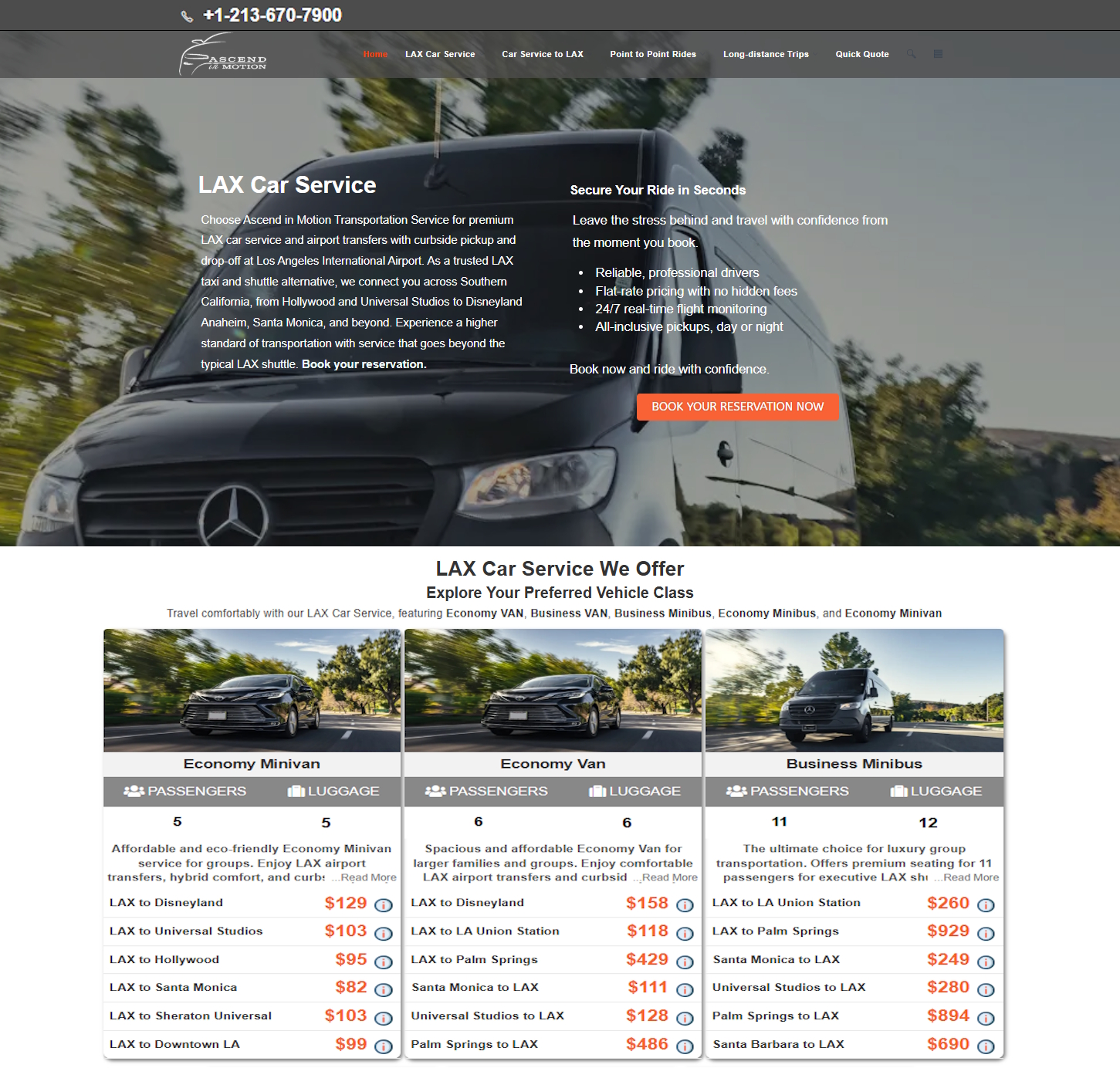
Ascendinmotion provides professional chauffeur-driven transportation across Southern California, with a focus on LAX airport transfers, long-distance travel, and point-to-point rides to destinations including Disneyland, Universal Studios, Hollywood, and Santa Monica. All vehicles are black minivans and Mercedes-Benz Sprinters, operated by vetted, professional drivers with fixed rates confirmed at booking. For travelers who want the reliability of a regulated service without the uncertainty of a metered cab, LAX airport transfers through Ascendinmotion deliver a consistent, professional experience every time. Learn more about what separates a premium airport car service from a standard taxi before your next trip.
FAQ
What is a cab service vs. a taxi service?
A cab service and a taxi service are the same thing. Both terms describe licensed, demand-responsive passenger transport where a driver takes you to a destination you control.
How do taxi services calculate fares?
Most taxi services use a taximeter or fixed contract rate to calculate fares. Taximeters record distance and time; contract rates set a fixed price for a specific route, which is common at airports.
Is a rideshare app the same as a taxi service?
Rideshare apps like Uber and Lyft fall under the same industry classification as traditional taxis but operate under different licensing rules. The key difference is that rideshare drivers cannot legally accept street hails in most cities.
Can a taxi legally refuse to serve a passenger with a disability?
No. Under federal non-discrimination rules, U.S. taxi providers cannot refuse service or charge extra fees to riders with disabilities who can board the available vehicle.
How do I book a taxi service for LAX airport pickup?
You can book through a local taxi dispatch phone line, a ride-hailing app, or a pre-booked car service. For LAX specifically, pre-booked fixed-rate services eliminate fare uncertainty caused by traffic on the 405 and I-10 corridors.
