

Taxis win on cost when you drive fewer than a moderate number of miles per month in a city with reliable service. Car ownership wins when you commute daily, carry passengers regularly, or live somewhere taxis are scarce. Three inputs decide which side you land on: your monthly mileage, your total fixed ownership cost per month, and your average taxi fare per trip. Non-cost factors, though, can override the math entirely.
Before running the numbers, check these three inputs:
- Monthly miles driven (or trips taken if you rarely own a car)
- Total fixed ownership cost per month (loan/lease, insurance, registration, depreciation)
- Average taxi or ride cost per trip, including tips and surge
If parking is expensive, your schedule is unpredictable, or you travel with heavy luggage regularly, those factors often matter more than the breakeven number alone.
Key Takeaways
Taxis beat car ownership on cost when monthly mileage is low and fixed ownership costs are high, but ownership wins decisively once daily commuting pushes trip volume above the breakeven threshold.
| Point | Details |
|---|---|
| Breakeven rule | Divide total monthly ownership cost by average taxi fare to find the trip volume where costs are equal. |
| Short-trip rule | For urban trips under 3 miles with reliable service, on-demand taxis usually cost less than the per-mile ownership equivalent. |
| Parking and insurance as deal-breakers | High parking costs or expensive insurance can tip the math toward taxis even at moderate mileage. |
| When to choose flat-rate car services | Airport runs, group travel, and long-distance point-to-point trips often favor pre-booked flat-rate services over metered taxis. |
| Ascendinmotion for reservation-based travel | Ascendinmotion provides flat-rate LAX transfers and Southern California point-to-point service without the fixed costs of ownership. |
Table of Contents
- What does it really cost to own a car each month?
- How taxi pricing works and what to include in your estimate
- How to calculate your personal breakeven point
- Pros and cons beyond the dollar amount
- Which option fits your situation?
- A step-by-step checklist to make your final decision
- When a premium car service beats both taxis and ownership
- How does each option affect the environment?
- How available are taxis compared to having your own car?
- Safety: how do taxis and personal cars compare?
- The math tells you what to do, but it rarely tells the whole story
- Reliable point-to-point transport without owning a car
- Sources
What does it really cost to own a car each month?
Car ownership splits cleanly into fixed costs (you pay them whether the car moves or not) and variable costs (they scale with how much you drive). Both matter when comparing car ownership vs taxi spending.
Fixed monthly costs:
- Loan or lease payment (or the opportunity cost of tying up capital in a paid-off vehicle)
- Auto insurance, a core fixed expense that varies by driver profile, vehicle type, and state, as the Insurance Information Institute explains
- Registration and taxes, which vary by state and vehicle value
- Depreciation, the largest hidden cost most owners undercount
Variable costs (scale with miles):
- Fuel (most predictable variable)
- Routine maintenance: oil changes, filters, brake pads
- Tires (roughly every 40,000–60,000 miles)
- Repairs (unpredictable; budget a reserve)
- Parking and tolls (can be fixed or variable depending on your city)
Depreciation annualized — a simple formula:
(Purchase price − Estimated resale value) ÷ Years owned = Annual depreciation
Annual depreciation ÷ 12 = Monthly depreciation cost
Example: A $32,000 vehicle resold for $18,000 after five years loses $14,000 total, or $2,800 per year, which is $233 per month, before a single tank of gas.
Pro Tip: Add a maintenance reserve of at least $75–$100 per month even if the car feels new. Skipping it means a single repair bill wipes out months of “savings” you thought you had over taxis.
How taxi pricing works and what to include in your estimate
A taxi is a point-to-point vehicle for hire. Fare structures vary widely across cities and countries, covering everything from traditional metered hackney carriages to app-dispatched private hire vehicles. Understanding what you are actually paying for is the first step in a fair taxi vs car comparison.
Typical fare components:
- Flag/drop fee: a flat charge just for getting in
- Per-mile rate: the main variable charge
- Per-minute rate: applies when the vehicle is slow or stopped
- Minimum fare: a floor that applies on very short trips
- Booking or platform fee: common with app-based services
- Airport, congestion, or toll surcharges: often added automatically
- Tip: typically 15–20% in the US
- Waiting time: charged when you keep the driver waiting
Short urban trip example (3 miles, light traffic): flag fee + 3 miles + tip could total a moderate amount depending on city.
Medium trip example (12 miles, airport run): flag fee + mileage + airport surcharge + toll + tip could reach a moderate to high amount in many US metros.
Surge pricing is the wildcard. Regulated meter taxis offer more predictable fares; app-based services can multiply base rates during peak demand. For scheduled trips, apps like Curb offer upfront pricing and advance scheduling, which removes most of the uncertainty.
Pro Tip: For airport runs, always check whether a flat-rate option exists before booking a metered ride. Many cities and services publish fixed airport fares that are cheaper and more predictable than a metered trip in traffic.
How to calculate your personal breakeven point
The breakeven formula is straightforward. You need to know at what monthly trip volume taxis cost the same as owning a car.
The formula:
Total monthly ownership cost ÷ Average cost per taxi trip = Breakeven trips per month
If you take fewer trips than that number, taxis are generally cheaper. More trips, and ownership tends to be more economical.
Assumptions to declare before calculating:
- Miles per month
- Fuel price per gallon and vehicle MPG
- Insurance cost per month
- Maintenance reserve per month
- Parking cost per month
- Average taxi trip length and all-in cost (including tip and fees)
- Number of trips per month
Worked example A: Urban low-mileage driver
Assumptions: 400 miles/month, mostly short trips, $120/month parking, $130 insurance, $233 depreciation, $450 loan, $75 maintenance, $47 fuel (400 mi ÷ 30 mpg × $3.50).
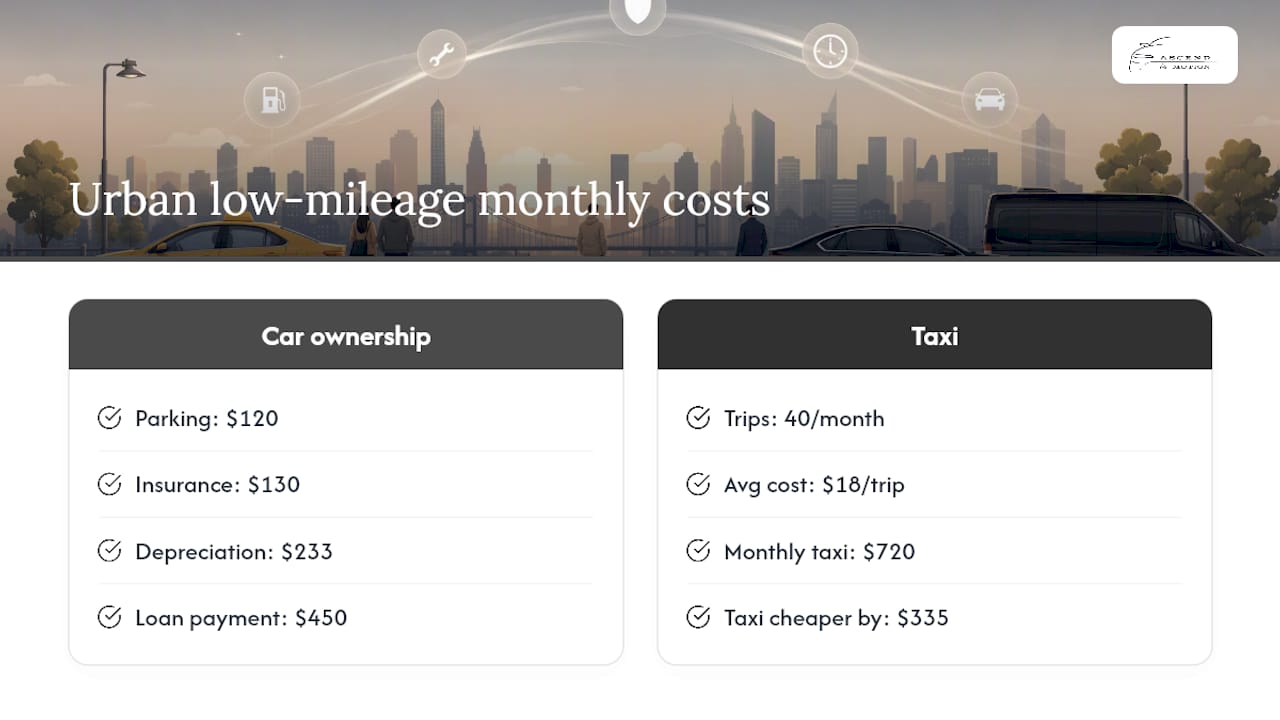
Monthly ownership cost: an estimated value around typical costs
Taxi alternative: 40 trips/month at an average all-in cost of $18 per trip.
Monthly taxi spend: ~$720
Winner: Taxis are generally more cost-effective in this situation, by roughly $335/month. At this mileage and trip pattern, the fixed costs of ownership are often too high relative to actual use.
Worked example B: Suburban daily commuter
Assumptions: 1,200 miles/month, $50/month parking (free at work), $130 insurance, $233 depreciation, $450 loan, $75 maintenance, $140 fuel (1,200 mi ÷ 30 mpg × $3.50).
Monthly ownership cost: an estimated value around typical costs
Taxi alternative: 60 trips/month at an average all-in cost of $28 per trip (longer suburban distances).
Monthly taxi spend: an estimated value around typical costs
Winner: Ownership is generally more cost-effective in this situation. Higher mileage spreads fixed costs across more trips, and longer suburban fares make taxis expensive fast.
As one European cost comparison illustrates, a single airport taxi ride in some cities can cost more than a multi-day car rental, which shows how quickly per-trip taxi costs compound on frequent travelers.
Assumptions: $3.50/gal fuel, 30 mpg, $450 loan, $130 insurance, $233 depreciation, $75 maintenance reserve. Adjust all figures to your local conditions.
Pros and cons beyond the dollar amount
Cost is only part of the taxi or car decision. These qualitative factors often tip the balance when the math is close.
Car ownership: pros and cons
Pros:
- Available instantly, 24/7, no wait time
- Full control over route, temperature, and music
- Handles grocery runs, kids’ car seats, and large luggage without extra fees
- No surge pricing on bad weather days
Cons:
- Parking hassles in dense cities (time and money)
- You are responsible for all maintenance and repairs
- Depreciation erodes value regardless of use
- DUI risk if you drive after drinking
Taxis and ride services: pros and cons
Pros:
- No maintenance, insurance, or depreciation responsibility
- Productive travel time (you can work or rest)
- Flat-rate car services offer flight tracking, guaranteed pickups, and included tolls for scheduled travel
- No parking costs
Cons:
- Wait times vary, especially in low-density areas or bad weather
- Surge pricing can double fares during peak hours
- Less reliable at 2 AM in suburban or rural areas
- Accumulates cost fast for frequent, long-distance trips
Real-world micro-scenarios:
- Airport run with two checked bags: a taxi or pre-booked car service beats driving yourself when airport parking costs $25–$40/day for a week-long trip.
- Grocery run with kids: owning a car wins clearly. Loading groceries and car seats into a taxi is impractical.
- Last-minute late-night plans: taxis work well in dense cities; in suburbs, availability drops and surge pricing spikes.
Which option fits your situation?
Car hire or ownership tends to be more economical for groups of three or more and for trips of five or more days. Taxis and public transport generally win for solo travelers on short city breaks. Here is how common situations map out:
- Dense urban, low mileage (under 500 mi/month): Taxis or ride services usually win. Fixed ownership costs are hard to justify.
- Daily suburban commute (over 800 mi/month): Ownership wins. High mileage spreads fixed costs efficiently.
- Family with kids and luggage: Ownership wins. Flexibility and cargo space are hard to replicate with taxis.
- Occasional long road trips: Ownership wins if you already have a car; otherwise, a rental is often cheaper than a taxi for distances over 100 miles.
- Night-shift worker in a city: Taxis can work, but check 3 AM availability in your specific area before relying on them.
- Tourist on a short city break: Taxis or transit win clearly. Parking, navigation, and rental logistics add friction with no benefit.
Local factors that can flip these outcomes: very high parking costs (tips ownership toward taxis), poor taxi availability in your neighborhood (tips taxis toward ownership), and heavy surge patterns during your typical travel hours.
A step-by-step checklist to make your final decision
Use this numbered process to reach a decision within a week, not a month of overthinking.
- Gather your monthly miles. Pull your last three months of odometer readings or gas receipts.
- Collect fixed ownership costs. Add loan/lease, insurance, registration (annualized), and depreciation.
- Estimate your average taxi trip cost. Include tip, fees, and a realistic surge buffer (add 20% for peak-hour trips).
- Run the breakeven formula. Monthly ownership cost ÷ average taxi trip cost = breakeven trips/month.
- Run a sensitivity check. Change each input by ±20% and see if the winner flips. If it does, the decision is marginal.
- Answer these questions before deciding:
- How often do I travel with luggage or kids?
- Is parking free at home and work?
- Are taxis reliably available at 2 AM in my area?
- Do I drive for reasons taxis cannot cover (errands, spontaneous trips)?
- Set a decision deadline. If the breakeven result is marginal, test taxis exclusively for 30 days before buying or keeping a car. Track every fare. The real number will be clearer than any estimate.
For airport bookings specifically, the airport taxi booking guide walks through how to lock in fares and avoid last-minute surge surprises.
When a premium car service beats both taxis and ownership
For certain trips, neither a metered taxi nor a personal vehicle is the best tool. Pre-booked, chauffeur-driven car services offer a distinct set of advantages that matter most when reliability and comfort are non-negotiable.
Concrete benefits of premium car services:
- Flat, pre-quoted pricing that includes tolls and fees, so the final bill matches the estimate
- Real-time flight monitoring for airport pickups, meaning the driver adjusts to delays automatically
- Meet-and-greet service, useful after a long international flight when you do not want to navigate a taxi queue
- Larger vehicles (black minivans, Mercedes-Benz Sprinters) for groups or travelers with significant luggage
- Professional, vetted drivers and consistent punctuality
Where flat-rate transfers are cost-competitive:
- Airport runs where parking would cost $30–$50 for a multi-day trip
- Group travel where splitting a flat rate beats three separate taxi fares
- Long-distance point-to-point trips (Los Angeles to Las Vegas, for example) where a metered taxi is impractical
The trade-off is honest: premium car services cost more per trip than a standard metered taxi for short urban hops. The value shows up on scheduled, longer, or group trips where predictability and comfort justify the premium. For LAX-specific comparisons, the private car service vs ride-share guide covers the cost and convenience gap in detail.
How does each option affect the environment?
The environmental picture in a taxi vs personal vehicle comparison is more nuanced than it first appears.
High-occupancy taxi and ride services, in theory, reduce the total number of vehicles on the road. In practice, however, app-based taxis often deadhead (drive empty between fares), which can increase total vehicle miles traveled in a city.
Electric vehicles, whether privately owned or operated as taxis, cut tailpipe emissions significantly. Purpose-built electric taxis like the LEVC TX are engineered specifically to lower operating emissions for taxi operators, which changes the environmental calculus for fleets in cities that have adopted them.
For the average traveler, the clearest environmental lever is trip consolidation: fewer, fuller trips beat more, emptier ones regardless of who owns the vehicle. Choosing a shared ride or a larger vehicle that carries a group is more impactful than the ownership model alone.
How available are taxis compared to having your own car?
Availability is where car ownership has an unbeatable structural advantage. Your car is there when you need it, at any hour, in any weather, without a wait.

Taxi and ride service availability, by contrast, depends heavily on location and time. In dense urban cores like Manhattan, central London, or downtown Los Angeles, wait times are typically short and supply is reliable around the clock. Move to a suburban neighborhood or a smaller city, and the picture changes fast. Late-night availability drops, surge pricing appears more often, and occasional service gaps can leave you stranded.
App-based platforms have improved urban availability considerably. Services like Curb allow advance scheduling, which removes the wait-time risk for planned trips. Pre-booked car services go further, guaranteeing a driver at a specific time regardless of demand conditions.
The practical rule: if your life includes regular early-morning airport departures or late-night returns, either own a car or pre-book a service. Relying on on-demand taxis for time-sensitive trips is a gamble that occasionally loses.
Safety: how do taxis and personal cars compare?
Both modes carry real safety considerations, and neither is categorically safer than the other.
Personal vehicle safety depends almost entirely on the driver. Fatigue, distraction, and impairment are the leading causes of crashes, and all three are driver-controlled variables. Owning a car also means you absorb the full liability of any accident.
Taxis and professional car services shift the driving responsibility to a licensed, often background-checked driver. Regulated taxi drivers typically meet local licensing standards. Premium car services add an additional layer: vetted, professionally trained chauffeurs with clean records. For travelers who are unfamiliar with local roads, driving at night, or arriving after a long flight, handing the wheel to a professional reduces risk meaningfully.
The honest caveat: not all taxi or ride drivers are equal. Regulated meter taxis in most cities operate under stricter licensing than some app-based alternatives. If safety is a priority, pre-booked services with verified driver credentials offer the most consistent standard.
The math tells you what to do, but it rarely tells the whole story
The breakeven formula is genuinely useful. Run it honestly with your real numbers and it will point you in the right direction most of the time. But the cases where people get the decision wrong are almost never math errors. They are assumption errors.
The most common one: underestimating taxi availability at the exact hours and locations that matter to you. Someone who commutes at 8 AM in a dense city and runs the math correctly will conclude taxis are cheaper, and they are right. The same person who then needs a ride at 2 AM on a Tuesday in a suburb discovers the assumption was wrong in the one moment it mattered most.
Can I get a reliable ride at the worst-case time and place I actually need one? If the answer is uncertain, ownership or a pre-booked service wins by default. The cost difference rarely justifies the schedule risk.
Reliable point-to-point transport without owning a car
For travelers who want consistent, reservation-based transport without the fixed costs of ownership, Ascendinmotion offers flat-rate airport transfers and point-to-point service across Southern California, including LAX arrivals and departures, long-distance routes to Las Vegas, San Diego, and Palm Springs, and group travel in black minivans and Mercedes-Benz Sprinters.
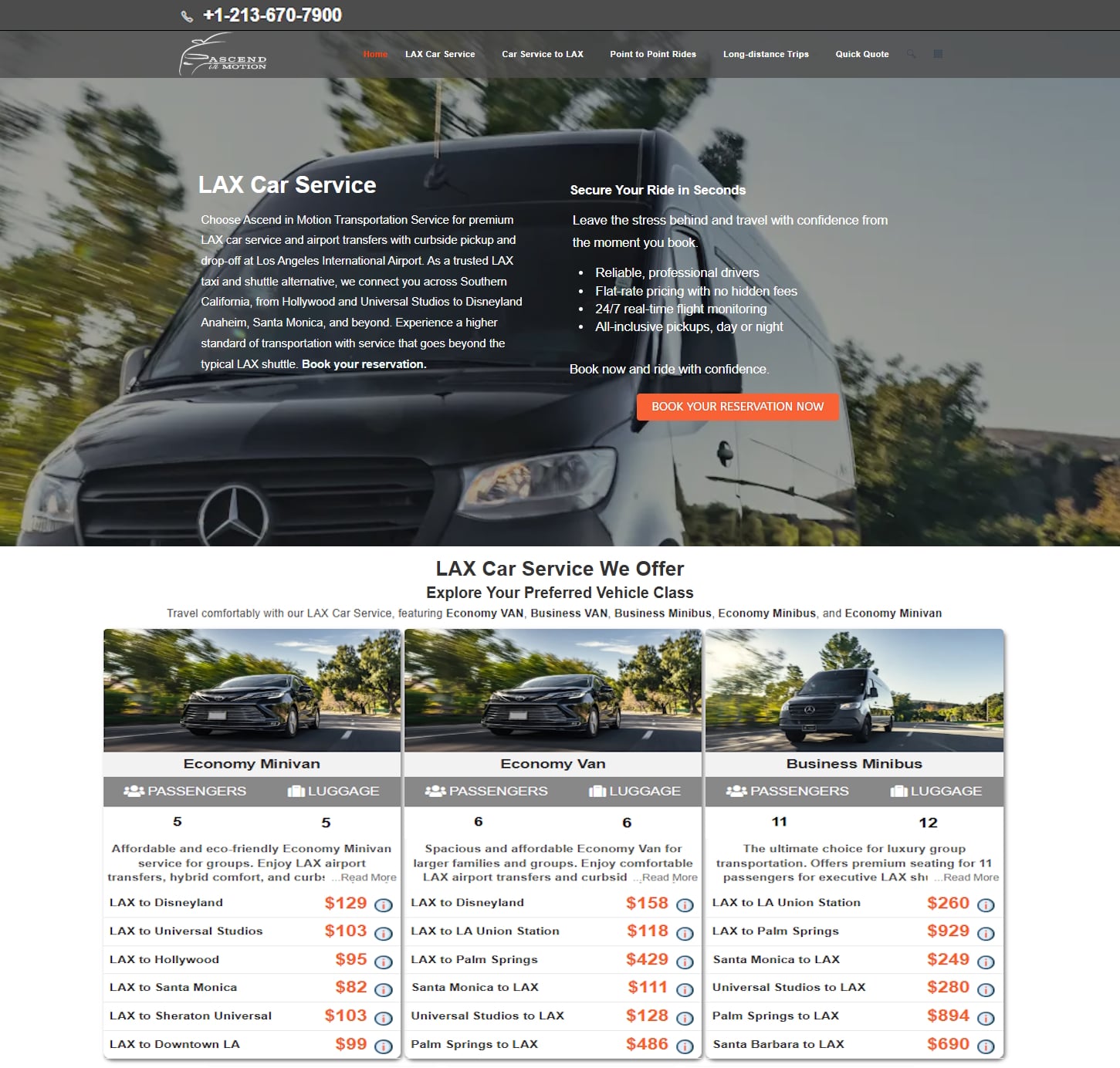
Alt text: Ascendinmotion black Mercedes-Benz Sprinter ready for LAX airport transfer pickup
What sets the service apart for travelers who have run the breakeven math and decided against ownership:
- Flat rates quoted before you book, with no surge surprises
- Real-time flight monitoring so your driver adjusts to delays automatically
- Meet-and-greet at the terminal for a stress-free arrival
- Vehicles sized for groups, from luxury SUVs to Sprinter vans
Reserve your transfer online or check California car service options to see routes and pricing before you commit.
Sources
Use these resources to pull local numbers and run the breakeven test with real data.
- Taxi – Wikipedia
- Taxi or Car Rental in Europe? Cost Comparison Infographic | AutoEurope
- Car Hire vs Taxi vs Public Transport | BestCarHire Blog
This article is general information, not a substitute for advice from a qualified financial advisor. Consult a qualified financial professional about your own circumstances before acting on anything here.

