
The best route for a road trip from Los Angeles to Las Vegas is Interstate 15, a straight shot of roughly 270 miles that takes about four to five hours nonstop. From there, pick your style:
- Nonstop: nothing but gas and gas pedal, done in half a day.
- Day trip: two or three curated stops woven into the drive.
- Scenic overnight: a Mojave National Preserve or Joshua Tree detour that turns the drive into the trip.
Traffic bites hardest on Friday afternoons and Sunday returns, and summer heat can turn a routine stop into a real problem if you’re unprepared.
Key Takeaways
The fastest, most reliable way to cover Los Angeles to Las Vegas is I-15, and the right add-ons depend entirely on how much time you’re willing to trade for scenery.
| Point | Details |
|---|---|
| Best route | I-15 covers roughly 270 miles in about 4 to 5 hours nonstop. |
| Halfway stop | Barstow is the practical break point for fuel, food, and restrooms. |
| Traffic timing | Leave before 10 AM Fridays and avoid Sunday afternoon returns to skip Cajon Pass gridlock. |
| Desert prep | Carry extra water, watch A/C load on grades, and top off fuel before Baker. |
| Alternative option | Ascend in Motion offers flat-rate chauffeured transfers for travelers who’d rather skip the driving entirely. |
Table of Contents
- Which Route Should You Take from LA to Las Vegas?
- Three Ready-to-Drive Itineraries for This Trip
- What Are the Best Stops Between LA and Las Vegas?
- What Should You Know Before Driving Through the Desert?
- What Should You Do Right Before or After Vegas?
- Should You Drive Yourself or Book a Bus, Shuttle, or Car Service?
- How Ascend in Motion Makes This Drive Easier
- Frequently Asked Questions
- Sources
Which Route Should You Take from LA to Las Vegas?
I-15 north is the route almost everyone ends up taking, and for good reason. You pick it up via the I-10 or I-210 corridor out of the LA basin, merge onto I-15 near San Bernardino, and stay on it essentially the whole way to the Las Vegas Strip. It’s fast, well-served by gas stations and food, and it’s the version of this drive every rental car GPS defaults to.
Scenic alternatives add real time but real payoff. A Route 66 detour through Victorville and Barstow adds maybe 20 to 30 minutes. A full Mojave National Preserve loop, with a stop at Kelso Dunes, can add two to three hours depending on how far you wander — a great choice for those interested in off-road adventures in Utah and California. Joshua Tree, tacked onto the front of the trip, is closer to a half-day detour.
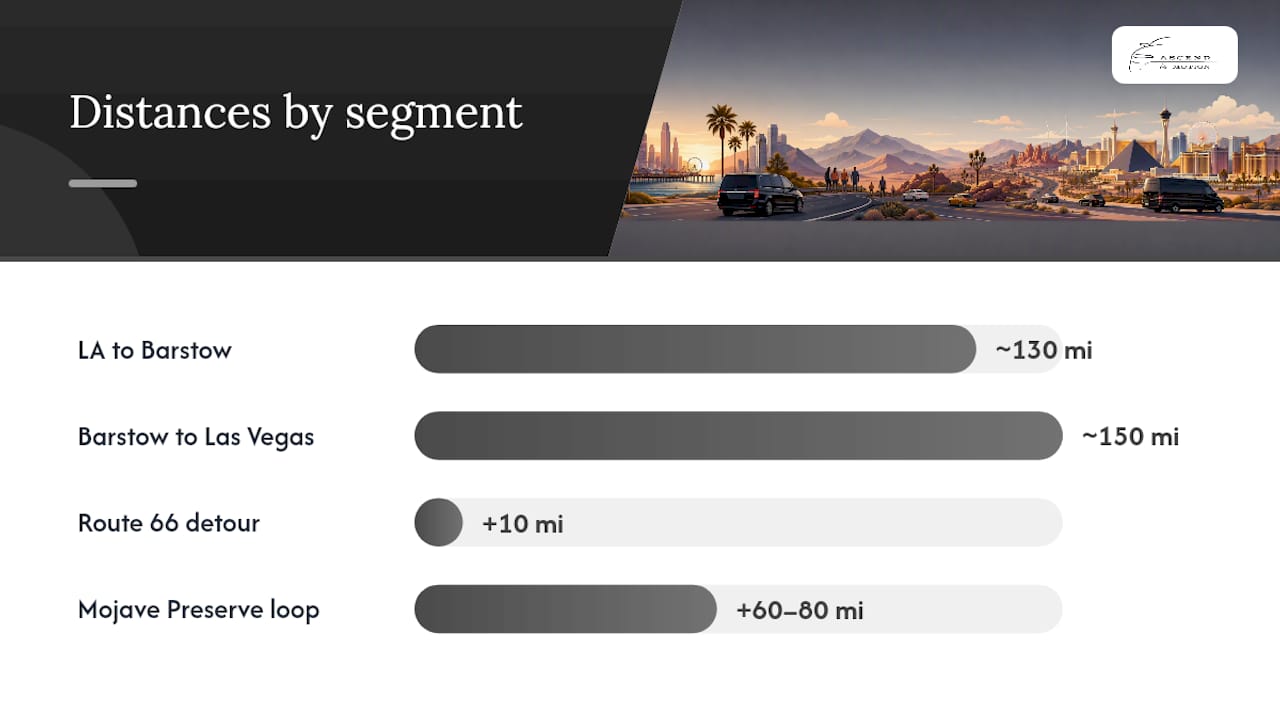
| Route Segment | Distance | Typical Drive Time |
|---|---|---|
| LA to Barstow (halfway point) | ~130 miles | ~2 hours |
| Barstow to Las Vegas | ~150 miles | ~2.5 hours |
| Route 66/Victorville detour add-on | +10 miles | +20 to 30 minutes |
| Mojave National Preserve loop | +60 to 80 miles | +2 to 3 hours |
Cajon Pass, the mountain climb just past San Bernardino, is the one spot on this whole route where traffic regularly backs up. Check conditions on Caltrans’ road information page before you leave, especially in winter or on holiday weekends.
Three Ready-to-Drive Itineraries for This Trip
Not every traveler wants the same pace, so here’s how to match a plan to your schedule.
1. The nonstop run. Leave LA before 7 AM or after 7 PM to dodge Cajon Pass traffic. Stop once in Barstow for gas and food. You’ll roll into Vegas in about five hours including that one break.
2. The day-trip plan. Depart by 9 AM. Hit the California Route 66 Museum in Victorville (20 minutes), grab lunch in Barstow, then swing through Calico Ghost Town (60 to 90 minutes) before finishing the drive. If you’re pressed for time, skip Calico and keep the museum stop.
3. The scenic overnight. Leave early, detour into Mojave National Preserve for a few hours at Kelso Dunes, then either camp at a preserve campground booked through Recreation or push on to Baker for a motel. Pack checklist: extra water, sunscreen, a paper map (cell service drops out in the preserve), and a full tank before you turn off the interstate.
What Are the Best Stops Between LA and Las Vegas?
Here’s the order that actually works, grouped by state so you know when you’re switching time zones and cell carriers.
California stops:
- Cajon Pass summit. A quick pull-off with mountain views as you climb out of the LA basin. Budget 10 minutes, mostly to snap a photo and stretch.
- California Route 66 Museum, Victorville. A small, well-curated stop packed with vintage cars and neon signs. Budget 20 to 30 minutes. Pro Tip: Go on a weekday morning; weekend afternoons draw bus tours that clog the parking lot.
- Elmer’s Bottle Tree Ranch, Oro Grande. A free roadside art installation of hundreds of glass bottles on welded steel “trees.” Budget 20 minutes. There’s no restroom or food here, so treat it as a photo stop only.
- Barstow / Rainbow Basin. Your real halfway point for fuel, food, and restrooms, with a scenic geological detour a few miles north if you have extra time. Budget 30 to 60 minutes for the town, more if you drive out to Rainbow Basin.
- Calico Ghost Town. A restored 1880s silver-mining town with shops, mine tours, and gunfight reenactments on busier days, managed as a regional park with posted hours and ticketing. Budget 60 to 90 minutes. Pro Tip: Buy your ticket online during peak season weekends to skip the entrance line.
- Peggy Sue’s ’50s Diner, Yermo. A kitschy milkshake-and-burger stop that’s practically a rite of passage on this drive. Budget 30 to 45 minutes.
- Baker, home of the World’s Tallest Thermometer. Your last real services before the empty stretch toward Nevada. Budget 15 to 20 minutes, longer if you’re eating.
- Kelso Dunes / Mojave National Preserve turnoff. The detour entrance for dunes, volcanic cinder cones, and the historic Kelso Depot. Budget two or more hours if you’re actually going in.
Nevada stops:
- Primm. Outlet shopping, casinos, and a roller coaster visible from the highway, right at the state line. Budget 30 to 60 minutes.
- Seven Magic Mountains, near Jean. Seven towers of neon-painted boulders, one of the most photographed roadside art pieces in the desert. Budget 20 minutes.
- Jean / Primm to Vegas final leg. Twenty-five minutes of open highway before the Strip skyline appears.
What Should You Know Before Driving Through the Desert?
Top off your tank in Barstow or Baker. Services thin out fast between Baker and Primm, and prices tend to spike at the isolated stations in between.
Fuel, Charging, and Safety Checklist
- Fill up in Barstow or Baker, not after.
- If you’re driving an EV, Primm-area resorts and many Las Vegas hotels offer charging, but confirm plug type and availability before you leave LA.
- Pack an extra gallon of water per person and watch your A/C load on steep climbs to avoid overheating.
- Summer highs regularly hit 100 to 110°F or more along this corridor, so skip midday hikes at any detour stop.
- I-15 is toll-free the entire way, so your only real cost is fuel.
Quick math: a sedan getting 30 MPG covering 270 miles burns about nine gallons. At roughly $4.50 a gallon, that’s around $40 one way, before food or park fees.
What Should You Do Right Before or After Vegas?
If you arrive early, Seven Magic Mountains and a quick loop toward Red Rock Canyon are easy add-ons west of the Strip. Heading east instead? Save Hoover Dam options for a separate trip; it’s a detour, not a drive-through.
- Book hotels Tuesday through Thursday for noticeably lower rates than weekend nights.
- Time your check-in for late afternoon so you still get an evening on the Strip.
- Reserve EV charging or valet parking ahead of major weekends and convention dates, when hotel garages fill up fast.
Should You Drive Yourself or Book a Bus, Shuttle, or Car Service?
Driving gives you total control over stops, but it’s not the only way to make this trip, and it’s worth weighing the alternatives honestly.
Intercity buses run this corridor daily and are the cheapest option by far, often a fraction of what gas and parking cost. The trade-off is obvious: you’re locked into their schedule, there are no roadside detours, and the ride can run five to six hours with stops of its own.
Shared shuttle services split the difference, offering door-to-pickup-point service at a lower cost than a private ride, but you’re still sharing the vehicle and the schedule isn’t yours.
A private car service solves the scheduling problem entirely. You set the departure time, the driver handles Cajon Pass traffic and desert navigation, and you can actually nap, work, or watch the scenery instead of managing it. For travelers who want the flexibility of a car without doing the driving themselves, this is worth comparing against a detailed breakdown of travel options between self-driving, shuttles, and chauffeured transfers.
If your trip starts at LAX rather than somewhere else in LA, that adds a layer of coordination self-driving doesn’t solve on its own, since you’re dealing with rental counters and terminal traffic before you even reach I-15.
A transport provider’s view on timing
I’ve watched plenty of travelers plan this drive down to the minute, then lose forty minutes to Cajon Pass or a bathroom line in Barstow. Build in an extra 30 to 60 minutes anywhere you can. On our own LA to Vegas runs, booking early and confirming the pickup window in advance is what keeps a five-hour trip from turning into six.
How Ascend in Motion Makes This Drive Easier
If planning eight stops, a fuel budget, and a desert heat checklist sounds like more logistics than vacation, Ascend in Motion offers a different way to cover the same 270 miles. You get door-to-door pickup, flat-rate pricing with no surprise fuel math, and a chauffeur who already knows how to route around a backed-up Cajon Pass.
Every vehicle in the fleet, whether it’s a luxury SUV or one of our Mercedes-Benz Sprinter vans, keeps luggage handling and passenger comfort covered, so heat and trunk space stop being your problem. Before booking, confirm three things: vehicle type for your group size, your preferred departure window, and flight monitoring if you’re starting from LAX. One transparency note: Ascend in Motion does not currently provide wheelchair-accessible vehicles, so travelers with that need should confirm alternate arrangements first.
Ready to skip the fuel stops and hand someone else the wheel? Reserve your LA to Vegas transfer and lock in your pickup window today.
Frequently Asked Questions
How long does the drive from Los Angeles to Las Vegas actually take?
Nonstop, expect about four to five hours covering roughly 270 miles. Add stops and that stretches to six or seven hours for a day-trip itinerary with two or three breaks.
What’s the best time of day to leave for this road trip?
Leave before 10 AM or after the evening rush to avoid Cajon Pass backups, particularly on Fridays. Sunday afternoons headed back to LA carry the same risk in reverse.
Is I-15 the only route, or are there scenic alternatives?
I-15 is the fastest and most direct option. A Route 66 detour through Victorville and Barstow, or a longer loop through Mojave National Preserve, both branch off the same highway and rejoin it further along.
Are there tolls on the drive from LA to Las Vegas?
No. I-15 is toll-free the entire way, so fuel is your main variable cost.
Is it cheaper to drive myself or book a private car service?
Driving yourself is usually cheaper on fuel alone, but a private car service adds flat-rate pricing, no parking hassle in Vegas, and a driver who knows the route, which matters more for groups or travelers who value their time over saving on gas.
Sources
- Mojave National Preserve (NPS)
- Los Angeles to Las Vegas: Ultimate Road Trip Guide — Visit Las Vegas
- California Department of Transportation — Roads
- Los Angeles to Las Vegas drive: The complete road trip guide

