
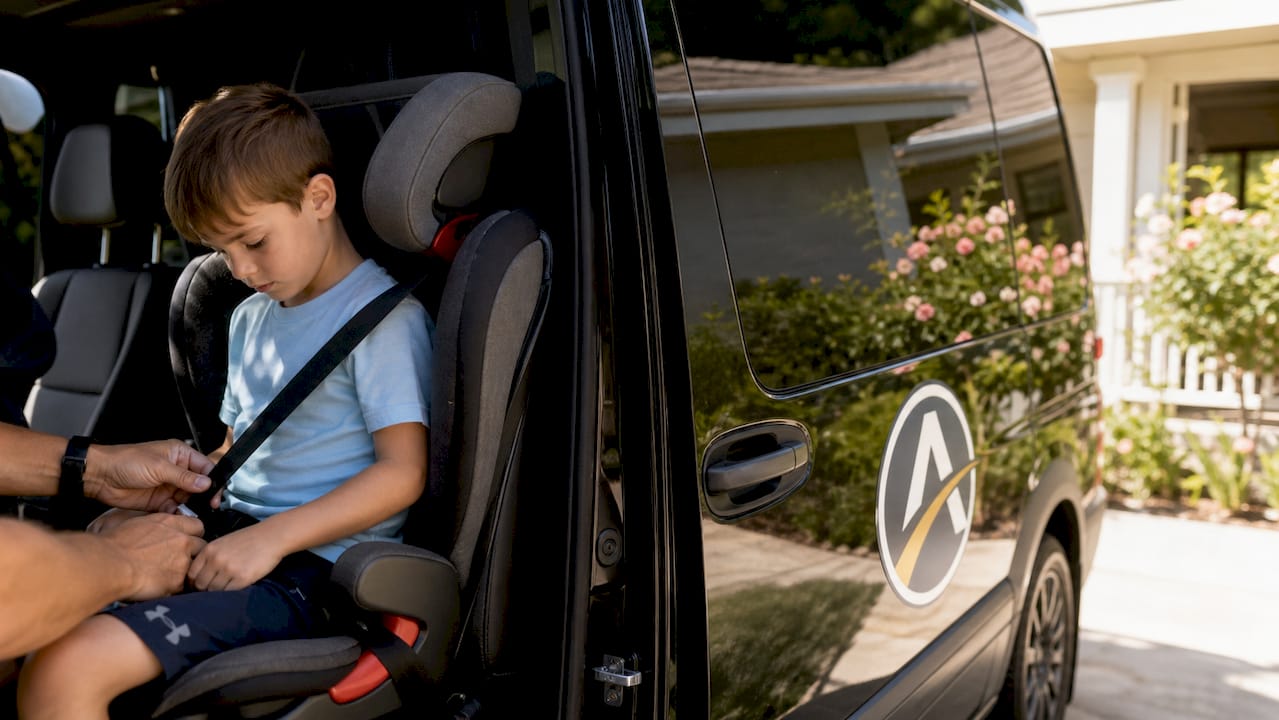
Your child needs a booster seat until the vehicle’s lap-and-shoulder belt fits properly on its own, typically starting around the age when kids are at least 8 years old and approximately 4’9" tall according to many state statutes, though the exact trigger depends on your state’s law. Until then, keep the booster in place. Beyond that legal floor, safety groups still recommend keeping kids in the back seat until age 13, since that position keeps them clear of frontal airbags during a crash.
TL;DR:
- Children typically need a booster seat until at least age 8 or 4’9" tall, depending on state laws and individual growth.
- The 5-step belt fit test must be passed for a child to safely skip the booster, ensuring proper belt positioning on the chest and hips.
- High-back boosters are recommended for vehicles lacking head support, while backless boosters work best in cars with adequate headrests.
- Correct belt routing and snugness are vital, with common mistakes including shoulder belts under the arm and lap belts on the stomach.
- Always verify booster seat fitment at certified check stations, especially when switching vehicles or traveling, to maximize safety.
Table of Contents
- Booster Seat Rules: A Quick Checklist Before Every Trip
- How Booster Seat Laws Vary by State
- The 5-Step Test for a Proper Seat Belt Fit
- High-Back vs. Backless Boosters: Which One Fits Your Situation
- Installation Mistakes That Quietly Cancel Out Protection
- What We’ve Learned Moving Families Through Los Angeles
- Booking a Family-Ready Ride in Los Angeles
- Sources
Booster Seat Rules: A Quick Checklist Before Every Trip
Before you buckle up, run through a few fast checks. They take less time than finding your keys, and they matter more.
- Confirm your child hasn’t outgrown the current seat’s height and weight limits. A forward-facing harness that’s maxed out means it’s booster time, not a stretch to “just one more year.”
- Run the 5-step seat belt fit test (covered in detail below) before deciding your child is ready to ditch the booster entirely.
- Check belt routing every single ride. Lap belt low across the hips, shoulder belt across the chest, no slouching for the whole trip.
- Traveling by taxi or rideshare? Bring your own backless booster, since most drivers won’t have one waiting for you.
Pro Tip: Keep a lightweight backless booster in your trunk or diaper bag if you travel often. It folds flat, weighs almost nothing, and saves you from scrambling when a rideshare shows up without one.
How Booster Seat Laws Vary by State
Federal guidance sets the safety baseline, but the actual legal requirement, the one that determines whether you get a ticket, comes from your state. NHTSA recommends keeping kids in each restraint stage until they exceed the manufacturer’s height and weight limits, then moving to a booster until the seat belt fits correctly on its own. That’s the safety standard. The legal standard is narrower and varies by state.
California is a useful example because its law is specific. Under the California Vehicle Code, children under eight must ride in a child passenger restraint in the back seat unless they’ve reached 4’9" in height. The California Highway Patrol puts it plainly: kids who are 8 years old or 4’9" tall may transition to a booster, but every child under 4’9" must be secured by something more than a standard seat belt regardless of age.
Other states follow similar logic with different numbers attached. Illinois generally requires child restraints through age 8. Georgia and Texas both use height and weight thresholds tied to booster use once a child ages out of a harness seat. None of these laws is identical, so a rule that applies driving through Nevada may not apply once you cross into California.
Exemptions exist too. Some states waive the requirement when a vehicle has no back seat, when a child has a documented medical condition that prevents standard restraint use, or in certain taxi and rideshare situations. If you’re unsure, your state’s DMV or highway patrol website is the fastest way to confirm the actual statute rather than relying on a blog post or a secondhand rule from a friend.
The 5-Step Test for a Proper Seat Belt Fit
Before you let your child skip the booster, the seat belt itself has to pass a specific test. This isn’t a guess. It’s the standard safety organizations and state agencies use to determine readiness.
- Does your child sit all the way back against the vehicle seat? No leaning forward, no perching on the edge.
- Do their knees bend naturally at the edge of the seat? If their legs stick straight out, they’re not tall enough yet.
- Does the shoulder belt cross the middle of the chest and shoulder? It should never cut across the neck or face.
- Does the lap belt sit low, across the upper thighs, not the stomach? A belt riding high on the belly can cause serious internal injury in a crash.
- Can your child stay seated like this for the entire ride? Not just for the first five minutes before sliding down.
If any of those five fail, the booster stays. Height around 4’9" is the rough benchmark where most kids start passing this test naturally, but bodies vary, and some ten-year-olds still need the boost. Crash injury data compiled by NHTSA consistently shows that vehicle crashes remain a leading cause of death for children between ages 1 and 13, and properly fitted restraints are one of the few variables parents fully control. If your child fails the test, don’t force it. Try adjusting the seating position first, and if that doesn’t fix it, keep the booster in the car for at least another few months.
High-Back vs. Backless Boosters: Which One Fits Your Situation
Not every booster does the same job. The two main styles solve different problems, and picking the wrong one for your vehicle undercuts the protection you’re paying for.
High-back boosters add head and neck support and route the shoulder belt through a guide at the right height. They’re the better call for younger kids just transitioning out of a harness, and for any vehicle with a low seatback or no built-in head restraint at that seating position.
Backless boosters are lighter, cheaper, and easy to toss in a trunk, but they only work safely when the vehicle’s own seat provides head support and the child can sit upright the whole ride. Some seats also convert from a harnessed seat into a booster as your child grows; manufacturer instructions will tell you the exact weight where that switch is appropriate.
- Check that the booster fits your specific vehicle’s seat shape and belt geometry, not just your child’s size.
- Confirm the weight and height range printed on the seat matches your child right now, not where they’ll be in six months.
- Favor a high-back model if your car’s rear seat lacks a headrest at that position.
Pro Tip: If you’re rotating between two vehicles, a backless booster is easier to move back and forth, but only if both cars have adequate headrests where your child sits.
Installation Mistakes That Quietly Cancel Out Protection
A booster isn’t a car seat in the traditional sense. It’s a belt-positioning device, meaning its entire job is getting the vehicle’s existing lap-and-shoulder belt to land in the right spots on your child’s body. Get the belt routing wrong, and the booster isn’t doing much.
The most common mistakes are simple ones. Kids tuck the shoulder belt under their arm or behind their back because it rubs their neck, which defeats the entire purpose. The lap belt rides up onto the stomach instead of sitting low on the thighs. Slack builds into the belt over a long drive, and a slouching child slides out of position without anyone noticing until you glance in the mirror.
For seats with a harness stage, use the vehicle’s lower anchors when the manual calls for them, and add a top tether whenever your convertible seat has one. NHTSA is direct on this point: always follow both the car seat’s manual and your vehicle’s owner manual, since installation methods vary by model.
| Common Mistake | What It Does | Quick Fix |
|---|---|---|
| Shoulder belt under arm | Removes upper body protection in a crash | Route belt across chest, adjust booster position |
| Lap belt on stomach | Risk of internal injury on impact | Reposition belt low across upper thighs |
| Slack in the belt | Allows body to move forward on impact | Pull belt snug before every drive |
| Slouching posture | Shifts belt off protective points | Use higher back support or reposition booster |
If you’re ever unsure whether your setup passes muster, a certified car-seat-check station can verify it in minutes, and most are free. State DMV and NHTSA sites list nearby locations and upcoming fitting events.
What We’ve Learned Moving Families Through Los Angeles
Families ask us constantly about booster seats when booking a car service, and the answer always comes back to preparation. If you’re hopping into a taxi or rideshare downtown, bring your own booster, since most providers don’t stock them and policies vary widely from one driver to the next.
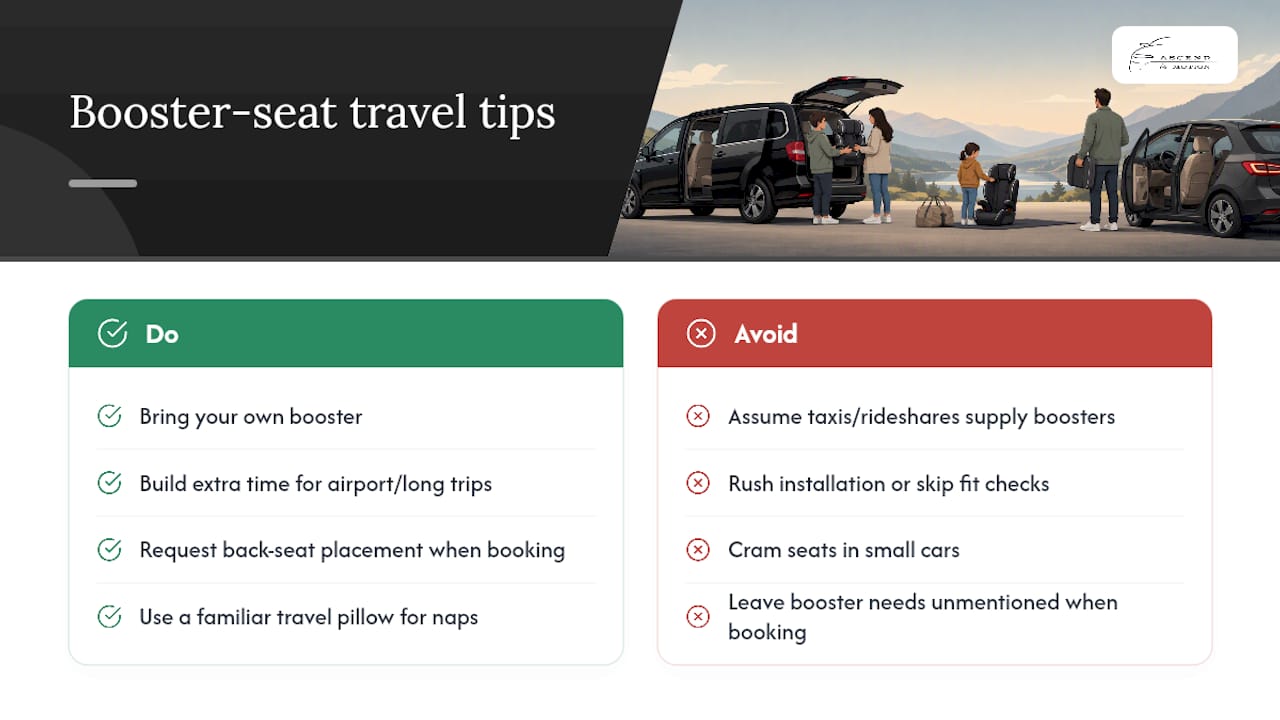
For airport transfers or longer trips out to places like Palm Springs or Santa Barbara, build in extra time for installation and a mid-trip fit check, especially after a flight when everyone’s tired and rushing. A familiar travel pillow or headrest cushion helps younger kids nap comfortably in a booster on longer drives. Larger families traveling together often do better in a Sprinter group transfer, where there’s more room to install seats correctly without cramming.
When you book with Ascendinmotion, mention your child’s booster needs and request back-seat placement up front. Our black minivans and Mercedes-Benz Sprinters give you the space to get the fit right the first time.
— Sirus
Booking a Family-Ready Ride in Los Angeles
Booster seat rules exist for a simple reason: a poorly fitted belt does far less to protect a child in a crash than a properly positioned one. Whether you’re driving your own car or booking a ride, that same 5-step fit test applies every time.
If you’re traveling through Los Angeles with kids and want a car service that takes seating arrangements seriously, Ascendinmotion’s airport transfer service lets you flag booster needs and back-seat placement when you book, so there’s no scrambling curbside. It’s one less thing to worry about on a trip that already has enough moving parts.
Sources
- California Vehicle Code — Child safety belt and passenger restraint requirements
- California Highway Patrol — Child Safety Seats

